
Restaking 2026: The Shift to Delegated Security
Restaking has evolved from a novel experimental mechanism into the foundational layer of Ethereum’s security model. By 2026, the distinction between staking and restaking has blurred, as the protocol now serves as the primary collateral engine for a vast ecosystem of decentralized services. This shift marks a departure from isolated validator sets toward a shared security pool, where capital efficiency is maximized through delegated trust.
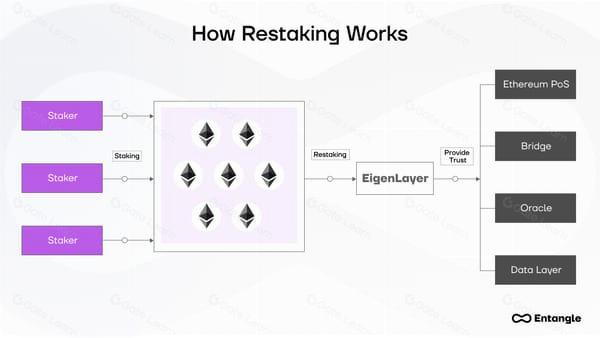
EigenLayer V2 has matured this architecture by refining the Active Validated Services (AVS) framework. Rather than requiring validators to run redundant, siloed infrastructure, the protocol allows them to "restake" their existing Ethereum consensus layer security to support new networks. This creates a multi-layer yield engine, transforming trapped capital into a versatile resource that underwrites everything from decentralized oracle networks to modular blockchain sequencers.
Liquid Restaking Tokens (LRTs) have further democratized access to this yield. By allowing users to retain liquidity while committing their stakes to additional security layers, LRTs have turned static staking positions into dynamic financial instruments. This liquidity is critical for market depth, enabling restakers to adjust their exposure without the lengthy exit queues that plague traditional unstaking processes.
The result is a more robust security landscape. As more value locks into these delegated security markets, the cost of attacking the underlying Ethereum layer rises exponentially. Restaking 2026 is no longer just about yield; it is about securing the broader decentralized economy through a unified, efficient security layer.
EigenLayer V2: Upgrades and Active Set Dynamics
EigenLayer V2 marks a structural shift in the restaking 2026 landscape, moving from a permissioned beta to a more robust, economically efficient protocol. The upgrade addresses critical friction points in capital allocation and risk management, fundamentally altering how restaked assets interact with the broader Ethereum ecosystem. By refining the mechanism for managing the Active Set, EigenLayer aims to maximize the utility of restaked capital while maintaining strict security guarantees.
At the core of V2 is a redefined Active Set dynamic. Previously, the process for adding and removing operators from the set was often opaque, leading to fragmentation and reduced effective security. V2 introduces a more transparent, algorithmic approach to operator participation. This change ensures that only operators with sufficient stake and proven performance remain active, directly correlating security provision with capital efficiency. The result is a tighter coupling between validator responsibility and reward distribution, reducing the risk of under-collateralized services.
The technical upgrades also focus on improving the efficiency of restaked capital. V2 streamlines the slashing conditions and improves the composability of restaked assets across different middleware services. This allows for more granular risk assessment, enabling operators to tailor their security offerings to specific needs without over-committing their entire stake. For the restaking 2026 era, this means a more liquid and adaptable market where capital can flow to the highest-yielding, most secure opportunities with minimal friction.
To understand the current market sentiment and volatility surrounding these upgrades, it is helpful to observe the broader Ethereum network trends, as EigenLayer's performance is intrinsically linked to ETH's health and staking dynamics.
Liquid restaking tokens: liquidity and yield
Liquid Restaking Tokens (LRTs) solve the liquidity trap that has long defined restaking. When you restake ETH, your assets are typically locked to secure Active Verification Services (AVSs), removing your ability to trade or use the capital elsewhere. LRTs mint a tradable derivative representing your staked position, allowing you to maintain exposure to restaking yields while keeping your capital mobile. This mechanism is central to the restaking 2026 landscape, transforming static staked ETH into a dynamic, multi-purpose asset.
The primary utility of an LRT is dual-layer yield generation. You earn the base Ethereum staking reward while simultaneously collecting fees from the AVSs your token helps secure. Protocols like EigenLayer facilitate this by allowing third-party operators to build services on top of the shared security model. As the ecosystem matures in 2026, the distinction between simple liquid staking and active restaking becomes clearer: LRTs offer the flexibility to capture both yield streams without sacrificing liquidity.
Adoption metrics reflect the growing reliance on these instruments. The broader liquid-staking category has reached approximately $39.4 billion in total value locked, with significant daily fee volumes flowing through tracked protocols. This volume underscores the market's preference for LRTs that offer transparent yield distribution and seamless integration with decentralized finance (DeFi) platforms. In restaking 2026, the ability to swap, lend, or provide liquidity with your LRT is not just a convenience—it is the primary driver of capital efficiency.
While LRTs offer superior flexibility compared to locked staking, they introduce smart contract risk. The derivative nature of these tokens means you are exposed to the underlying protocol's security and the validator operators' performance. Investors must weigh the premium yield against the potential for slashing or de-pegging events. Despite these risks, the liquidity premium provided by LRTs makes them the preferred vehicle for sophisticated participants navigating the restaking 2026 environment.
Leading restaking 2026 protocols by TVL and utility
As the restaking 2026 landscape matures, capital has consolidated around a handful of dominant protocols. The liquid-staking category now holds approximately $39.4 billion in total value locked, with weekly protocol fees reaching $23 million as of May 2026. This concentration reflects a shift from speculative experimentation to infrastructure-grade reliability, where validators prioritize protocols that offer both yield diversity and robust slashing protection.
The top five protocols—EigenLayer, EtherFi, Symbiotic, Kelp DAO, and Karak—each serve distinct roles in the AVS (Actively Validated Service) ecosystem. While EigenLayer remains the foundational layer for most restaking activity, specialized competitors have carved out niches in liquid restaking tokens (LRTs) and modular security. Understanding their comparative strengths is essential for allocating capital efficiently in a high-stakes environment.
The following comparison outlines the core mechanics, TVL dominance, and primary use cases for these leading platforms. This data reflects the current market structure, where utility and security audits often outweigh pure yield claims.
| Protocol | TVL (Est.) | Yield Mechanism | Primary AVS Utility |
|---|---|---|---|
| EigenLayer | $12.5B | Native Restaking | General-purpose AVS foundation |
| EtherFi | $4.2B | LRT (Liquid Restaking Token) | Composable DeFi integration |
| Symbiotic | $1.8B | Custom Asset Restaking | Non-ETH asset security |
| Kelp DAO | $1.5B | LRT (rsETH) | Institutional-grade yield |
| Karak | $0.9B | Modular Security | Specialized AVS validation |
EigenLayer continues to command the largest share of restaking 2026 capital due to its first-mover advantage and extensive AVS network. Its native restaking model allows ETH stakers to secure multiple services simultaneously, creating a dense web of shared security. However, this concentration also introduces systemic risk, as a failure in a major AVS could potentially impact the broader restaking ecosystem.
EtherFi and Kelp DAO have differentiated themselves through liquid restaking tokens, which allow users to maintain liquidity while earning restaking yields. EtherFi’s eETH and Kelp’s rsETH are deeply integrated into DeFi protocols, enabling leveraged positions and yield farming strategies. This composability has driven significant TVL growth, particularly among retail and DeFi-native participants.
Symbiotic and Karak represent the newer wave of specialized restaking infrastructure. Symbiotic allows for custom asset restaking, enabling protocols to secure services using tokens beyond ETH. Karak focuses on modular security, offering flexible validation frameworks for niche AVSs. These protocols are gaining traction as the market seeks to diversify risk and expand the types of services that can be secured through restaking.
Slashing risks and smart contract exposure
Restaking 2026 amplifies yield potential, but it also concentrates risk. When you restake ETH, you are not just securing the Ethereum network; you are providing security to multiple Actively Validated Services (AVSs) simultaneously, such as oracles, bridges, and data availability layers. This multi-tasking creates a complex web of dependencies where a failure in one layer can impact your entire position.
The most immediate threat is slashing. If the underlying validator behaves maliciously or fails to perform its duties, the protocol can confiscate a portion of the staked assets. In a restaking context, this risk is compounded because a single slashing event on the base Ethereum layer can trigger penalties across all services relying on that validator set. You are essentially betting that no single point of failure will occur across a diversified portfolio of protocols.
Beyond slashing, smart contract vulnerabilities remain a critical concern. Restaking involves additional layers of code, including Liquid Restaking Tokens (LRTs) and the EigenLayer contracts themselves. Each new layer introduces potential attack surfaces for exploits, bugs, or governance failures. Due diligence is no longer optional; stakers must thoroughly audit the security track record of the AVSs they choose to support.
The landscape is shifting rapidly with EigenLayer V2, which aims to introduce more modular security frameworks. However, the fundamental principle remains: higher yields in the restaking economy are compensation for higher, more complex risks. Stakers must balance the desire for enhanced returns against the potential for catastrophic smart contract failures or slashing events.
Frequently Asked Questions About Restaking 2026
Can you still mine Ethereum in 2026?
No. Ethereum mining ended permanently on September 15, 2022, following the network’s transition to Proof of Stake. The shift removed the need for energy-intensive hardware, meaning all current yield generation on Ethereum relies on staking rather than mining. For 2026, the focus is entirely on how restaking protocols utilize this staked capital.
Why is ETH taking so long to unstake?
Unstaking delays are caused by a protocol rate limit, not a technical failure. The network caps exits at 256 ETH per epoch (approximately every 6.4 minutes). This limits the total network exit to about 57,600 ETH per day. When many users request withdrawals simultaneously, this fixed cap creates a backlog, extending the timeline for liquidity access during high-volume periods.
Is restaking 2026 safe for long-term holders?
Restaking 2026 strategies offer higher yields by reusing staked ETH as collateral for additional services, but they introduce new risks. If an Actively Validated Service (AVS) fails or is compromised, stakers may face slashing penalties. While the potential for compounded returns is significant, it requires careful monitoring of the specific protocols and their security audits.
No comments yet. Be the first to share your thoughts!