
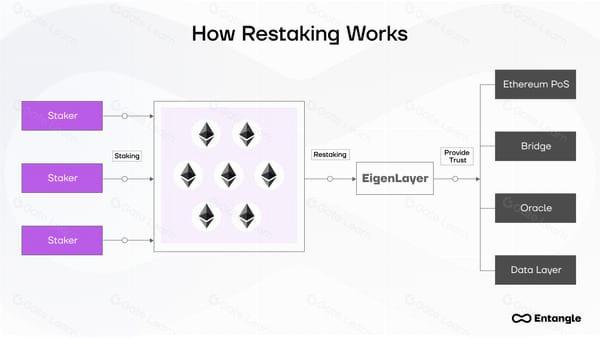
What restaking means in 2026
Restaking is the mechanism of using already-staked ETH to secure additional decentralized services, effectively reusing crypto-economic security across multiple protocols. While standard staking delegates validator duties solely to the Ethereum consensus layer, restaking allows stakers to opt into securing secondary networks, such as oracle networks, bridges, or other rollups, without deploying new capital or hardware.
The yield mechanics differ fundamentally from traditional staking. Standard staking returns a base yield derived from Ethereum block rewards and transaction fees. Restaking adds a specialized "security premium" on top of this base yield. This premium is paid by the protocols being secured, compensating restakers for the additional risk exposure and capital lock-up required to back those services.
As of early 2026, Ethereum solo staking offers approximately 2.8–3.2% base yield. Restaking protocols layer additional returns on this foundation, creating a composite yield that reflects both the security of the Ethereum base layer and the demand for security from emerging decentralized applications. This structural shift has turned validator nodes into multi-purpose security providers, changing how yield is generated and distributed in the ecosystem.
EigenLayer V2 structural upgrades
EigenLayer V2 introduces fundamental changes to the protocol's economic and security architecture, shifting from a single-operator model to a more distributed infrastructure. The core upgrade involves the introduction of "Operator Groups," which allow operators to form coalitions to provide services. This structural shift is designed to mitigate the systemic risk associated with single-operator failure, a vulnerability that has drawn scrutiny from regulators and institutional participants.
The economic model also evolves to address the "trapped capital" problem. By allowing restaked assets to participate in multiple Actively Validated Services (AVSs) simultaneously, V2 increases the utility of liquid staking tokens (LSTs). However, this multi-layered yield generation requires stricter slashing conditions to ensure that operators maintain sufficient collateral against their aggregated duties. The protocol now enforces a more granular risk matrix, where slashing penalties are proportional to the specific AVS involvement, reducing the penalty asymmetry that previously discouraged institutional participation.
Security is no longer a monolithic guarantee. Instead, V2 implements a modular security framework where each AVS can define its own slashing conditions. This means that an operator providing data availability might face different penalties than one providing oracle services. This modularity allows for more specialized security models but requires operators to carefully manage their exposure across different services. For investors, this translates to a more complex yield landscape where returns are directly correlated with the specific risk profile of the underlying AVS.
The transition to V2 also impacts how yield is calculated. Previously, restaking rewards were largely derived from Ethereum's base staking yield plus a small premium from early AVS adoption. With V2, the yield composition changes as operators compete for specific service contracts. This creates a more dynamic market for security, where prices for security services fluctuate based on demand. Investors must now monitor not just the ETH price, but the health and demand for specific AVS contracts to accurately assess their restaking returns.
Top LST and LRT protocols compared
The 2026 landscape for Liquid Staking Tokens (LSTs) and Liquid Restaking Tokens (LRTs) has shifted from speculative growth to structural yield optimization. As EigenLayer V2 matures, the distinction between simple staking derivatives and active restaking positions has become critical for portfolio risk management. Investors must now evaluate protocols not just by headline APY, but by the composition of that yield and the specific slashing risks retained.
The primary trade-off remains between yield magnitude and security complexity. Pure LSTs like stETH offer stability with lower returns, while LRTs such as ezETH and eETH leverage restaking to amplify yields but introduce dependency on Actively Validated Services (AVS) performance. The following comparison highlights the structural differences between the leading protocols.
| Protocol | Type | Yield Source | Risk Profile |
|---|---|---|---|
| Ether.fi | LRT | ETH staking + AVS | Moderate-High |
| Renzo | LRT | ETH staking + AVS | Moderate-High |
| Kelp DAO | LRT | ETH staking + AVS | Moderate |
| Lido | LST | ETH staking only | Low |
| Rocket Pool | LST | ETH staking only | Low |
Ether.fi and Renzo represent the high-yield end of the spectrum, deriving additional returns from restaking agreements. This approach increases capital efficiency but exposes holders to smart contract risk and potential slashing events if underlying AVSs misbehave. Kelp DAO has positioned itself with a slightly more conservative risk profile by focusing on established AVS partnerships, aiming to balance yield with stability.
In contrast, Lido and Rocket Pool remain the benchmarks for low-risk exposure. Their yield is derived solely from Ethereum consensus rewards, meaning they do not carry the additional slashing risk associated with restaking. For investors prioritizing capital preservation over yield augmentation, these LSTs provide a direct, uncorrelated exposure to ETH price action with minimal structural complexity.
Where the yield comes from
The total return on restaked assets is not a single metric but a composite of distinct revenue streams. The foundation is the base yield from Ethereum consensus layer staking, which typically ranges between 2.8% and 3.2% annually as of early 2026. This baseline compensates validators for block proposal and attestation duties.
Restaking adds a specialized "security premium" on top of this base. By depositing liquid staking tokens (LSTs) into EigenLayer, operators provide cryptographic security to Actively Validated Services (AVSs). These services—ranging from oracle networks to decentralized sequencers—pay operators in native tokens or transaction fees for their computational guarantees. The total yield is therefore the sum of the underlying ETH reward and the variable AVS rewards.
The cost of pooled security
This yield structure introduces specific structural risks that do not exist in solo staking. The primary concern is smart contract vulnerability. Restaking requires locking assets in complex smart contracts that mediate between the Ethereum consensus layer and multiple AVSs. A vulnerability in the EigenLayer core contracts or a specific AVS middleware can lead to partial or total loss of the staked principal.
Slashing conditions are the second major risk factor. In solo staking, slashing penalties are triggered by consensus-layer offenses, such as double-signing. In restaking, operators can be slashed for offenses committed on AVSs. If an operator fails to perform duties for an AVS or acts maliciously within that service, the penalty is enforced by the Ethereum consensus layer, burning the underlying ETH. This creates a "single point of failure" dynamic where the security posture of one AVS can impact the validator's entire stake.
Risk-reward asymmetry
The yield premium in restaking is essentially a risk-adjusted return. Higher yields often correlate with newer, less battle-tested AVSs that carry higher smart contract and operational risk. As the ecosystem matures, the security premium may compress as more operators compete for the same work, driving down the marginal reward per AVS. Investors must weigh the potential for higher APY against the non-linear risk of slashing events, which can erase months of accumulated yield in a single incident.
No comments yet. Be the first to share your thoughts!