
Restaking 2026: The Security Market Shift
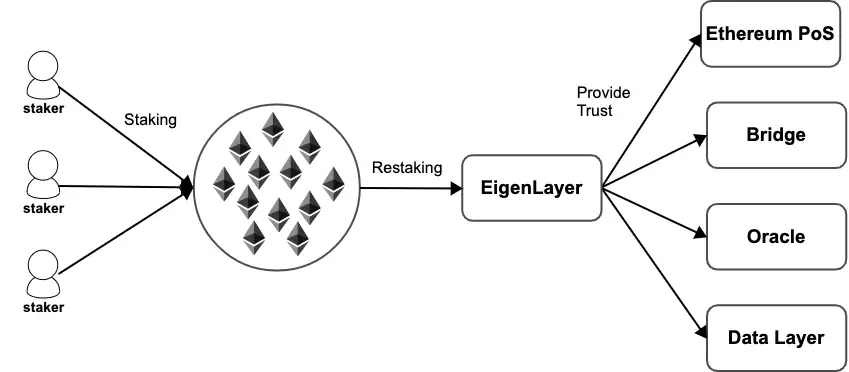
Restaking has evolved from a niche Ethereum experiment into the backbone of decentralized security. In 2026, the model has shifted from simple staking to pooled security, where validators reuse their existing staked ETH to secure additional networks and services. This mechanism, pioneered by EigenLayer, allows a single unit of capital to generate multiple layers of yield while simultaneously bootstrapping new infrastructure.
The economic implications are substantial. According to market research, the restaking platform market is projected to grow from USD 21.8 billion in 2026 to USD 198.7 billion by 2034, reflecting a compound annual growth rate of 31.2%. This expansion signals a structural change in how crypto assets are valued and utilized, moving beyond simple store-of-value dynamics to active security provisioning.
This shift creates a new security market where capital efficiency is paramount. Restakers can now participate in securing oracles, bridges, and rollups without committing additional capital, effectively leveraging their Ethereum stake. As the ecosystem matures, the distinction between "staking" and "restaking" blurs, with the latter becoming the dominant paradigm for securing high-value decentralized applications.
EigenLayer and the AVS Ecosystem
EigenLayer operates as the primary infrastructure for restaking, transforming Ethereum’s consensus security into a shared resource. Instead of locking staked ETH to secure only the base layer, the protocol allows validators to reuse their stake to support Actively Validated Services (AVS). This creates a pooled security market where the same cryptographic proof protects multiple protocols simultaneously.
AVS are specialized services that require independent validation. Examples include decentralized oracle networks, data availability layers, and bridge validators. By integrating with EigenLayer, these services tap into Ethereum’s massive security budget without needing to bootstrap their own validator sets. This reduces the fragmentation of security that has historically plagued new decentralized applications.
The ecosystem has scaled rapidly. By April 2026, EigenLayer secured tens of billions of dollars in restaked assets across more than 100 active services. This growth demonstrates how restaking moves beyond theoretical utility to become a foundational component of the broader crypto economy. The market now views security as a liquid, tradable commodity rather than a static protocol requirement.
Liquid Restaking Tokens vs Direct Restaking
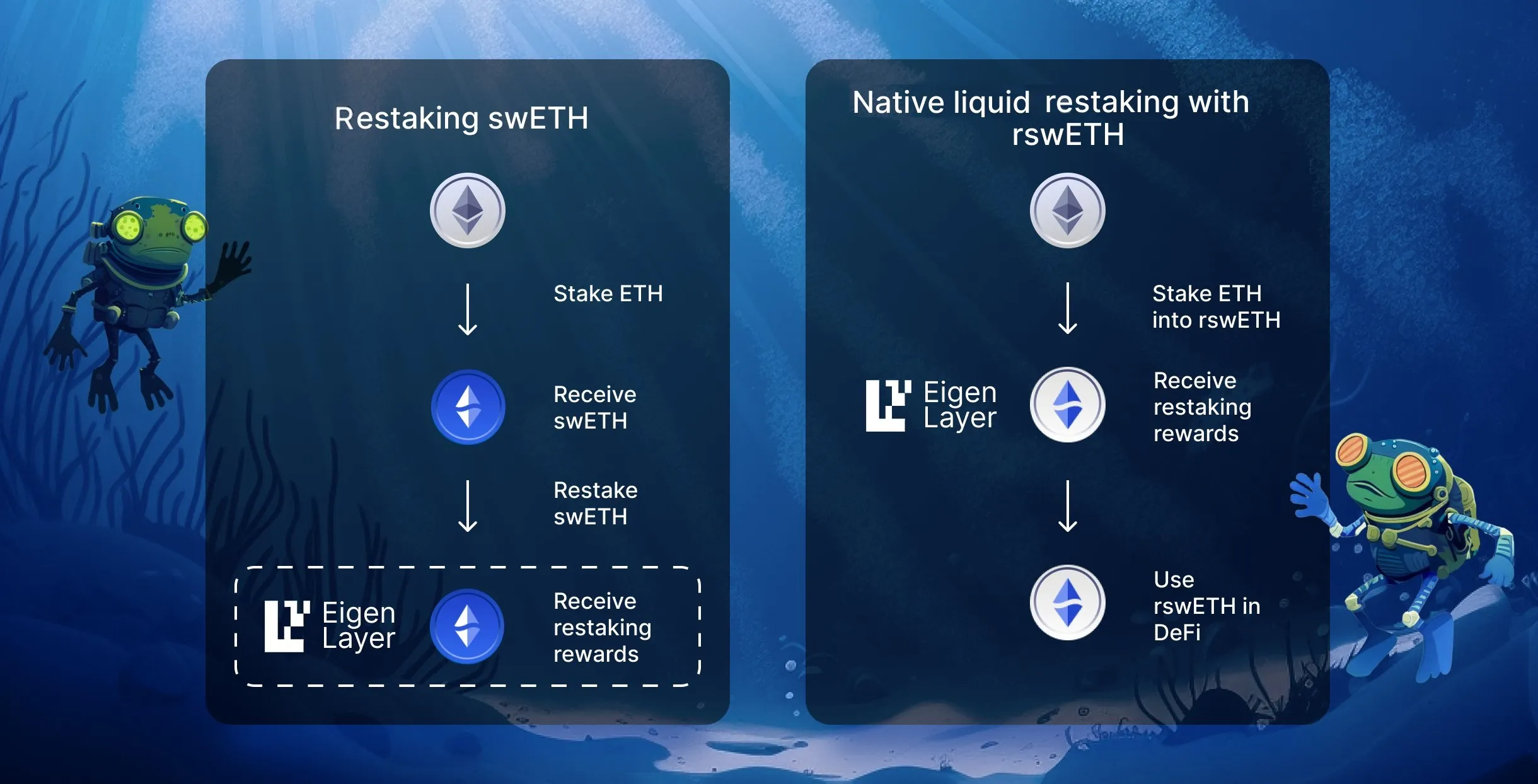
Liquid Restaking Tokens (LRTs) like Kelp DAO rebase the complexity of direct restaking into a single, transferable token. Instead of managing separate staking positions and EigenLayer restaking keys manually, users deposit ETH or stETH to receive an LRT that aggregates yield from both Ethereum consensus rewards and restaking points. This approach is particularly useful for capital efficiency, as the LRT can often be used as collateral in lending protocols or liquidity pools while still earning restaking rewards.
Direct restaking through EigenLayer offers lower fees and maximum transparency, but it requires active management. Users must bridge assets, stake them, and then restake them, locking up capital in multiple layers. The liquidity is fragmented; you cannot easily sell your restaked position without unwinding the entire stack. LRTs solve this liquidity trap by providing a unified token that represents the underlying yield-bearing position.
The tradeoff is complexity and counterparty risk. LRTs introduce smart contract risk at the LRT protocol layer. In April 2026, Kelp DAO experienced a significant security incident, highlighting the importance of auditing these additional layers. Direct restaking isolates risk to EigenLayer’s smart contracts, which have a longer track record. However, for users seeking yield optimization and capital flexibility, LRTs remain the dominant choice.
| Feature | Direct Restaking | Liquid Restaking (LRT) |
|---|---|---|
| Liquidity | Low (locked positions) | |
| High (transferable token) | ||
| Yield Source | ETH staking + restaking points | Aggregated (ETH + restaking + protocol fees) |
| Complexity | High (multi-step process) | Low (single deposit) |
| Risk Layer | EigenLayer only | EigenLayer + LRT protocol |
Security Risks and Slashing Events
Restaking amplifies yield by reusing the same staked assets to secure multiple protocols, but it also concentrates risk. When a validator signs a malicious block on any of these shared networks, the penalty is not limited to a single chain. Slashing can occur across the entire set of protocols the validator has opted into, potentially wiping out a significant portion of the underlying stake.
The April 2026 hack of Kelp DAO serves as a stark reminder of these vulnerabilities. As a liquid restaking protocol, Kelp DAO suffered one of the largest DeFi exploits of the year, demonstrating how smart contract flaws in the restaking layer can lead to total loss of user funds. This incident highlights that the security of your restaked assets is only as strong as the weakest protocol in the chain.
Beyond smart contract exploits, the complexity of shared security introduces new attack vectors. Validators must manage keys and configurations across multiple networks, increasing the surface area for errors. As the restaking ecosystem grows, the potential for cascading failures becomes a real concern for anyone allocating capital to these high-yield strategies.
Choosing a Restaking Strategy in 2026
Selecting a restaking protocol requires balancing yield potential against the complexity of managing multiple slashing conditions. As the security market expands, the choice between native EigenLayer restaking and Liquid Restaking Tokens (LRTs) depends on your technical comfort and risk tolerance.
Native restaking exposes you directly to every AVS (Actively Validated Service) you opt into. If one AVS fails or acts maliciously, your staked ETH is at risk. LRTs often abstract this by pooling risk or using smart contract safeguards, but you must read the specific risk-sharing model of the protocol.
LRTs like rsETH or ezETH provide liquidity, allowing you to use your restaked position elsewhere in DeFi. Native restakers lock their ETH, sacrificing liquidity for potentially higher, direct rewards. Calculate if the extra yield from native restaking justifies the loss of capital flexibility.
Restaking is a rapidly evolving sector. Prioritize protocols with transparent governance and multiple independent security audits. Check if the protocol has a bug bounty program and how quickly they respond to reported vulnerabilities. This due diligence is critical in a high-stakes environment.
| Feature | Native EigenLayer | Liquid Restaking Token |
|---|---|---|
| Slashing Risk | Direct exposure to all AVSs | Varies; often pooled or mitigated |
| Liquidity | Locked | Liquid (tradable) |
| Complexity | High (manual AVS selection) | Low (single token management) |
| Yield Source | Direct AVS rewards | Protocol share of AVS rewards |
-
Identify your maximum acceptable slashing threshold
-
Verify the audit history of the LRT or AVS
-
Calculate net yield after protocol fees
-
Ensure you have a plan to withdraw during market stress
Restaking 2026 FAQ
Restaking has shifted from a niche EigenLayer experiment to a foundational layer of Ethereum’s security market. Below are the most common questions about how it works and what to expect in 2026.
The market is moving fast. As more protocols integrate with EigenLayer, the distinction between simple staking and active security provision will become increasingly important for long-term holders.
No comments yet. Be the first to share your thoughts!