
What restaking means in 2026
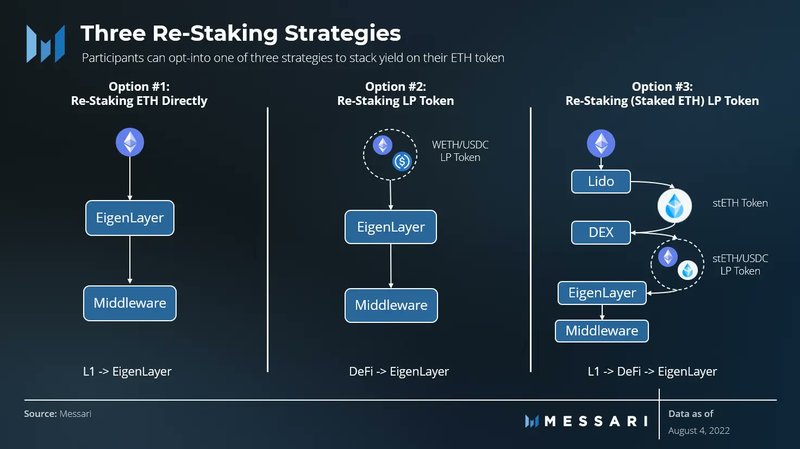
Restaking allows you to use your already-staked Ethereum to secure additional decentralized services. Instead of letting your staked ETH sit idle on the Ethereum mainnet, you delegate it to EigenLayer. These services, known as Actively Validated Services (AVS), require security to operate. By providing your staked ETH, you help secure these new networks while earning extra yield.
Think of your staked ETH as a foundation. Restaking builds additional structures on top of that foundation. You are not just securing the base layer; you are also validating data for oracle networks, bridge security, or decentralized compute. Each layer adds a new stream of rewards, but it also layers on risk.
The Ethereum Foundation defines this as a way to reuse staked ETH to secure other decentralized services. This approach increases capital efficiency. You earn from the base protocol and the AVS simultaneously. However, this convenience comes with complexity. Understanding the mechanics is essential before committing funds.
EigenLayer V2 and Protocol Upgrades
EigenLayer V2 introduces structural changes designed to stabilize the restaking ecosystem, focusing on reducing slashing risks and improving operator reliability. By unbundling the security model, the protocol aims to make restaking a more predictable component of Ethereum's infrastructure. This shift addresses the volatility concerns that have historically limited institutional adoption of restaking yield.
Reducing Slashing Risks
The most significant upgrade in V2 is the implementation of more granular slashing conditions. In earlier iterations, a single misbehavior by an operator could trigger penalties across multiple protocols, creating a cascading failure risk. V2 isolates these risks, ensuring that a fault in one intent does not automatically penalize the restaker’s entire stake. This isolation makes the security model more robust and less prone to systemic shocks.
Improving Operator Reliability
Operator reliability has been a bottleneck for restaking scalability. V2 introduces stricter validation requirements and better monitoring tools for operators. These changes ensure that only high-performing nodes participate in securing multiple protocols. The result is a more trustworthy network where restakers can have greater confidence in the uptime and integrity of their delegated assets.
Interoperability Standards
New interoperability standards allow EigenLayer to interact more seamlessly with other Layer 2 solutions and sidechains. This expansion increases the utility of restaked ETH without compromising its primary security function. The protocol now supports a wider range of intents, allowing restakers to earn yield from diverse sources while maintaining a single, secure stake.
Top liquid restaking tokens compared
Use this section to make the Restaking decision easier to compare in real life, not just on paper. Start with the reader's actual constraint, then separate must-have requirements from details that are merely nice to have. A practical choice should survive normal use, maintenance, timing, and budget. If a recommendation only works in an ideal situation, call that out plainly and give the reader a fallback path.
| Factor | What to check | Why it matters |
|---|---|---|
| Fit | Match the option to the primary use case. | A good deal still fails if it does not fit the job. |
| Condition | Verify age, wear, and service history. | Hidden condition issues erase upfront savings. |
| Cost | Compare purchase price with likely upkeep. | The cheapest option is not always the lowest-cost option. |
Security risks and slashing events
Use this section to make the Restaking decision easier to compare in real life, not just on paper. Start with the reader's actual constraint, then separate must-have requirements from details that are merely nice to have. A practical choice should survive normal use, maintenance, timing, and budget. If a recommendation only works in an ideal situation, call that out plainly and give the reader a fallback path.
The simplest way to use this section is to write down the must-have criteria first, then compare each option against those criteria before weighing nice-to-have features.
Where the extra yield comes from
The "security premium" in restaking is not magic; it is a direct payment for the computational work AVSs require. As of March 2026, solo stakers on Ethereum earn roughly 2.8–3.2% in base yield from consensus rewards. Restaking layers specialized services—such as data availability, oracle networks, or cross-chain bridges—on top of that foundation, allowing validators to earn additional rewards for securing these new protocols.
This structure fundamentally changes capital efficiency. Solo stakers typically lock their ETH into a single consensus layer, leaving their security resources idle for other use cases. In contrast, liquid restaking tokens (LRTs) allow that same capital to be reused across multiple AVSs simultaneously. This multiplexing of security means one unit of staked ETH can generate yield from several independent streams, rather than relying on a single source.
For solo stakers, this shift offers a choice: remain passive with lower overhead or delegate to an LRT to capture the AVS premium. The tradeoff is clear. Solo staking minimizes smart contract risk but caps yield at the base consensus rate. LRTs unlock trapped capital, turning a static asset into a multi-layer yield engine, though they introduce additional complexity and smart contract exposure.
Frequently asked questions about restaking
What is restaking?
Restaking allows Ethereum stakers to reuse their already-staked ETH to secure other decentralized services, known as Actively Validated Services (AVSs). Instead of locking capital in just one network, you can earn additional rewards from multiple protocols simultaneously. This creates a shared security model where the same underlying ETH protects both the base layer and secondary applications. For a deeper technical breakdown, see the official Ethereum documentation on restaking.
Can you still mine Ethereum in 2026?
No. Ethereum transitioned to a proof-of-stake consensus mechanism in 2022 with "The Merge." Proof-of-work mining is no longer possible on the Ethereum mainnet. In 2026, the only way to earn yield from ETH is through staking or restaking. Any platform claiming to offer "Ethereum mining" is likely a scam or referring to a different, unrelated blockchain.
Will Ethereum ever hit $4,000 again?
Price predictions are speculative and depend on broader market cycles, regulatory developments, and adoption rates. While Ethereum has surpassed $4,000 in previous cycles, no one can guarantee future price action. Restaking aims to improve capital efficiency and network utility, which may influence long-term value, but it does not directly dictate short-term price targets. Always verify current market data through trusted financial sources.
Which crypto will boom in 2026?
It is impossible to predict with certainty which specific cryptocurrency will outperform in 2026. The restaking ecosystem, including EigenLayer V2 and Liquid Restaking Tokens (LRTs), is expected to grow, but individual token performance varies widely. Investors should focus on the underlying technology and security models rather than chasing speculative trends. Diversification and thorough research remain the most reliable strategies for navigating crypto markets.
No comments yet. Be the first to share your thoughts!