
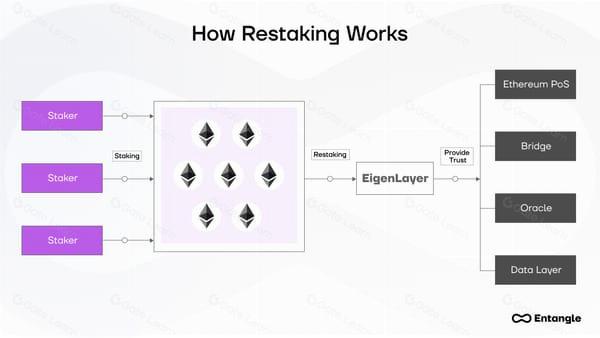
How restaking works
Restaking is a crypto-economic security mechanism that enables staked assets, such as Ethereum, to be reused to secure additional decentralized protocols. Unlike traditional staking, where your ETH solely supports the Ethereum network, restaking allows you to delegate that same security to other services, such as oracles or bridge validators.
When you restake, your assets remain locked in the Ethereum consensus layer, but you also sign off on the validity of transactions in secondary protocols. This creates a shared pool of security. Instead of each new protocol needing to bootstrap its own validator set, they can tap into the existing economic stake of Ethereum stakers. This reduces the cost of launching new infrastructure and increases the economic cost of attacking these services.
In return for providing this additional security, restakers earn extra rewards from the protocols they support. However, this reuse of security introduces unique risks. If a restaked protocol is compromised, the staker’s assets may be slashed. The mechanism effectively turns staked ETH into a multi-purpose resource, but it requires careful monitoring of the protocols you choose to back.
EigenLayer V2 Technical and Economic Shifts
EigenLayer V2 marks a transition from experimental restaking to a modular security infrastructure. The initial launch phase focused on proof-of-concept and early adopter incentives. V2 introduces structural changes designed to handle higher throughput and more complex slashing conditions without compromising network stability. These updates address the scalability bottlenecks that limited the protocol's utility in its early stages.
The core innovation lies in the unbundling of security. Instead of treating Ethereum's consensus layer as a monolithic shield, V2 allows validators to allocate specific portions of their stake to different Actively Validated Services (AVSs). This modular approach enables a single validator to secure a decentralized oracle network while simultaneously providing data availability for a Layer 2 rollup. The economic model shifts from generic yield farming to risk-adjusted compensation, where rewards are directly tied to the specific threat model of each service.
Slashing mechanisms have been refined to reduce false positives and operational complexity. Early iterations struggled with the coordination required to enforce penalties across diverse AVSs. V2 standardizes the fault proof generation process, allowing for faster and more automated penalty enforcement. This reduces the capital lock-up period for validators and lowers the barrier for new services to launch on the platform. The result is a more resilient ecosystem where security is a composable asset rather than a static resource.
EIGEN Price Analysis
The market reaction to these technical upgrades is visible in EIGEN's price action. As the protocol matures, investor sentiment shifts from speculative hype to fundamental valuation based on actual security services provided.
Top liquid restaking tokens
The liquid restaking token (LRT) market in 2026 has consolidated around a few dominant protocols that offer distinct risk-reward profiles. While the underlying mechanism remains the same—restaking ETH to secure other networks—the value capture and risk distribution vary significantly between protocols. Understanding these differences is essential for capital allocation in a high-stakes environment where smart contract risk is amplified by multiple layers of abstraction.
Ether.fi, Renzo, and Kelp Labs represent the current tier-one LRTs, each pursuing a different strategy for yield optimization and risk management. Ether.fi focuses on native restaking with a strong emphasis on community governance and diverse yield sources. Renzo prioritizes capital efficiency through its automated strategy manager, while Kelp Labs emphasizes institutional-grade security and modular infrastructure. The choice between them often comes down to whether a user prioritizes yield maximization or risk mitigation.
The following table compares the core metrics and strategic focus of these leading LRTs. Data reflects market conditions and protocol structures as of early 2026.
| Protocol | Core Strategy | Primary Yield Source | Risk Profile |
|---|---|---|---|
| Ether.fi | Native Restaking & Governance | ETH Staking + EigenLayer Points | Moderate |
| Renzo | Automated Capital Allocation | ETH Staking + Restaking Rewards | Low-Moderate |
| Kelp Labs | Modular Infrastructure | ETH Staking + Service Provider Fees | Low |
Ether.fi’s approach leans heavily into its governance token, eETH, which captures both staking rewards and points from the EigenLayer ecosystem. This makes it a popular choice for users seeking exposure to potential airdrops and governance influence, though it introduces higher complexity. Renzo, by contrast, uses a strategy manager to automatically allocate restaked capital across various protocols, aiming to smooth out yield volatility and reduce the need for active management. Kelp Labs focuses on providing the underlying infrastructure for other protocols, offering a more conservative, fee-based yield model that appeals to institutional players seeking stability over speculative upside.
When selecting an LRT, investors should weigh the trade-off between yield potential and smart contract exposure. Each protocol introduces additional layers of code, increasing the attack surface. The "security premium" added through restaking is not free; it is compensation for taking on systemic risk. As the modular security landscape evolves, protocols that demonstrate robust audit practices and transparent risk management will likely maintain their market leadership.
Yield sources and slashing risks
Use this section to make the Restaking decision easier to compare in real life, not just on paper. Start with the reader's actual constraint, then separate must-have requirements from details that are merely nice to have. A practical choice should survive normal use, maintenance, timing, and budget. If a recommendation only works in an ideal situation, call that out plainly and give the reader a fallback path.
The simplest way to use this section is to write down the must-have criteria first, then compare each option against those criteria before weighing nice-to-have features.
No comments yet. Be the first to share your thoughts!