
The Restaking Economy in 2026
Restaking has moved past the experimental phase of 2025 to become foundational infrastructure for Ethereum’s modular security layer. What began as a niche yield strategy is now a critical component of the broader crypto economy, with EigenLayer maintaining a stable Total Value Locked (TVL) exceeding $15 billion. This scale signals that restaking is no longer just a speculative play but a serious utility for securing shared validator sets across multiple protocols.
The market trajectory underscores this shift. According to market research projections, the restaking platform market is expected to grow from USD 21.8 billion in 2026 to USD 198.7 billion by 2034, representing a compound annual growth rate (CAGR) of 31.2%. This expansion reflects increasing demand for decentralized security services as more applications seek to leverage Ethereum’s consensus layer without building independent validator networks.
This growth is driven by the efficiency of shared security. Instead of each new blockchain or application paying for its own security infrastructure, restaking allows validators to delegate their Ethereum staking power to multiple services simultaneously. This creates a network effect where the security of the entire ecosystem strengthens as more actors participate, making restaking a vital pillar for the next generation of decentralized applications.
EigenLayer V2 and the shift to modular security
EigenLayer V2 marks a structural pivot from shared security to modular security. The update decouples the consensus layer from application-layer security, allowing validators to offer cryptographic guarantees to specific services without compromising the base Ethereum network. This architecture treats security as a composable resource rather than a monolithic block.
The core innovation lies in how EigenLayer manages these guarantees. Instead of forcing every new protocol to bootstrap its own validator set, the protocol allows "Actively Validated Services" (AVS) to tap into the existing stake of Ethereum validators. This creates a marketplace where security is rented rather than built from scratch, significantly lowering the barrier for new infrastructure projects.
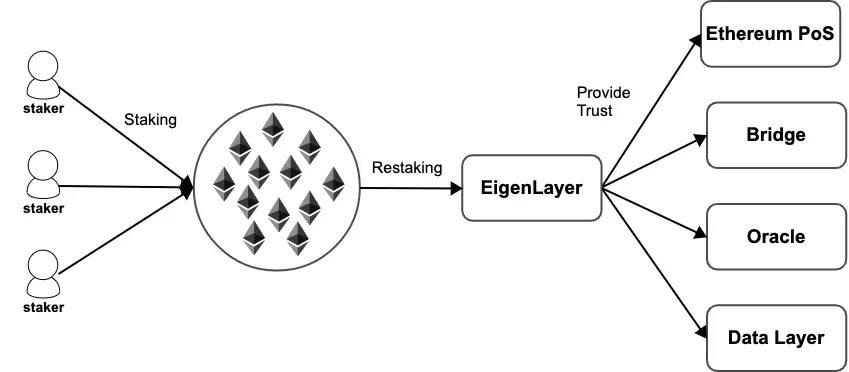
This modularity introduces a new risk vector: slashing conditions. When a validator opts into an AVS, it must adhere to that service's specific rules. If the validator misbehaves, it is slashed for that specific service, but the underlying Ethereum consensus security remains intact. This separation ensures that the failure of a single application does not cascade into a systemic collapse of the base layer.
The technical shift also requires more sophisticated operator infrastructure. Validators must now manage multiple sets of keys and ensure they can respond to the specific demands of various AVSs. This increases the operational complexity for node operators but provides a more resilient security model for the broader ecosystem.
Top restaking protocols by TVL
The restaking market has consolidated around a handful of protocols that handle the bulk of staked value. Comparing these platforms by total value locked (TVL) reveals where capital is flowing and which architectures are gaining traction. The following table breaks down the leading contenders, their core mechanisms, and their relative market positions.
| Protocol | TVL Rank | Primary Focus | Key Feature |
|---|---|---|---|
| EigenLayer | 1 | Ethereum PoS | Native EIP-4844 support & large ecosystem |
| EtherFi | 2 | Liquid Restaking | vETH2 & decentralized node infrastructure |
| Symbiotic | 3 | Modular Security | Customizable security configurations |
| Kelp DAO | 4 | Liquid Staking | rsETH yield optimization |
| Karak | 5 | Bitcoin Restaking | BTC restaking via Babylon bridge |
EigenLayer remains the dominant force, capturing the largest share of restaked assets due to its deep integration with Ethereum’s native staking infrastructure. Its ability to support EIP-4844 blob transactions gives it a technical edge in reducing costs for restakers. EtherFi follows closely, leveraging its liquid restaking token (vETH2) to attract capital seeking decentralized node operation capabilities.
Symbiotic distinguishes itself through modular security, allowing protocols to customize their security parameters rather than relying on a one-size-fits-all model. This flexibility has drawn significant TVL from projects requiring tailored risk profiles. Kelp DAO and Karak round out the top five, with Kelp focusing on yield optimization through rsETH and Karak pioneering Bitcoin restaking via the Babylon bridge, tapping into a new asset class for restaking yields.
How Restaking Yield Works and What Can Go Wrong
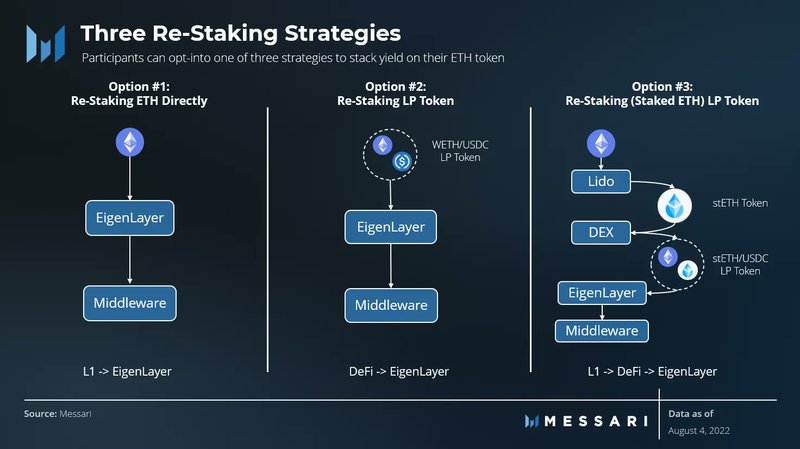
Restaking generates yield by stacking security. When you stake ETH on Ethereum, that capital is locked. Restaking protocols like EigenLayer allow you to reuse that same staked ETH to secure additional services, known as Actively Validated Services (AVS). These services include oracles, bridges, and new blockchain networks. By providing security to multiple layers simultaneously, your single asset earns multiple streams of rewards. This process turns "trapped" capital into a multi-layer yield engine, significantly boosting the effective return on your initial stake.
However, this efficiency comes with concentrated risk. The primary danger is slashing. If a validator node you delegated to or operated behaves maliciously or fails to perform its duties, the protocol can confiscate a portion of your staked ETH. In a restaking context, a single failure can trigger slashing across multiple AVS layers, compounding the loss. Unlike simple staking, where the penalty is isolated to Ethereum’s consensus layer, restaking exposes your principal to the operational integrity of every service you support.
Smart contract risk is the second major threat. Restaking involves complex layers of smart contracts managing delegation, rewards, and slashing conditions. A vulnerability in any of these contracts—whether in the core protocol or a specific AVS—can lead to total loss of funds. The code is often new, untested at scale, and subject to rapid iteration. As the ecosystem expands to include more diverse services, the attack surface grows, making rigorous audit verification and understanding the specific risks of each AVS critical for participants.
Frequently asked questions about restaking
Should I invest in Ethereum in 2026?
Ethereum’s May 2026 price prediction targets $2,240, with a range of $2,080–$2,260. ETH is currently below its 200-day moving average at $2,116.80, and the monthly RSI at 36 signals oversold conditions. A monthly close above $2,260 would confirm bullish momentum heading into Q2 2026. While restaking offers yield opportunities, ETH price volatility remains the primary risk factor for new capital.
Is restaking safer than holding ETH in a cold wallet?
Restaking is not a storage solution; it is an active security participation mechanism. Unlike a cold wallet, which isolates your assets from network activity, restaking locks your ETH to secure additional services like EigenLayer V2 or modular chains. This exposure introduces smart contract risk and slashing penalties if the underlying protocol misbehaves. It is best viewed as a yield-generating utility, not a passive vault.
How does restaking differ from traditional staking?
Traditional staking secures the Ethereum consensus layer alone. Restaking allows you to "reuse" that same secured ETH to validate other networks or protocols simultaneously. This creates a modular security model where one asset backs multiple services. While this increases potential yield, it also concentrates risk: if one restaked service fails, your entire restaked position could be slashed.
What are the main risks of restaking in 2026?
The primary risks are slashing events, smart contract vulnerabilities, and liquidity constraints. Slashing occurs if the validator node you are supporting acts maliciously or goes offline, resulting in a portion of your ETH being burned. Additionally, restaked assets are often locked for extended periods, reducing your ability to react to market downturns. Always verify the audit status of any restaking protocol before deploying capital.
No comments yet. Be the first to share your thoughts!