
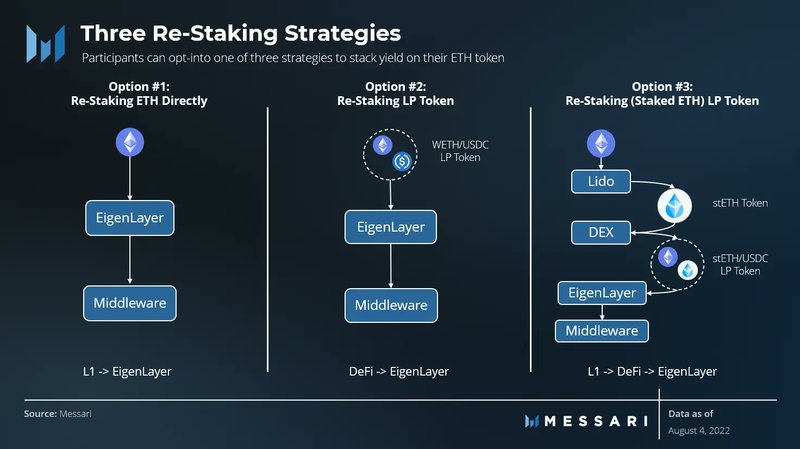
The restaking ecosystem stabilizes as infrastructure
Restaking has moved past the speculative hype of 2025 and settled into its role as core blockchain infrastructure. In 2026, the narrative has shifted from chasing unsustainable yields to building robust security layers for new decentralized networks. The market is no longer defined by volatile, fleeting rewards but by the steady accumulation of total value locked (TVL) in protocols that provide tangible utility.
EigenLayer remains the dominant force in this space, holding approximately 93% of the restaking market share. With over $19 billion in TVL, it has established itself as the primary gateway for Ethereum stakers looking to extend the security of their assets to other applications. This concentration of capital reflects a broader industry trend: participants are prioritizing protocol reliability and long-term viability over short-term, high-risk returns.
Yields in the restaking sector have normalized, typically ranging between 4% and 6% for base Ethereum staking rewards. While additional returns are possible through Active Validated Services (AVSs), the overall landscape is characterized by stability rather than explosive growth. This maturation suggests that restaking is becoming a foundational element of the Ethereum ecosystem, providing shared security to a growing array of decentralized services.
The underlying asset driving this infrastructure is Ethereum itself. The performance and stability of ETH remain central to the restaking narrative, influencing both the security assumptions and the economic incentives for participants.
How EigenLayer V2 upgrades shared security
EigenLayer V2 shifts the restaking model from a simple yield aggregator to a modular security layer. By introducing improved cryptographic proofs, the protocol allows Actively Validated Services (AVS) to tap into Ethereum’s decentralized validation power without requiring each service to build its own validator set. This shared security approach means capital remains efficient while security scales across multiple networks simultaneously.
The mechanism relies on verifiable credentials and slashing conditions that are enforced on Ethereum. When you restake ETH, you are not just locking it away; you are assigning it to specific AVS contracts. These contracts define the rules of engagement. If a validator acts maliciously against an AVS, the cryptographic proofs allow Ethereum to detect the fault and slash the staked assets. This creates a direct financial incentive for honest behavior across the entire ecosystem.
This upgrade is critical for the growth of the restaking sector. EigenLayer currently commands 93% of the market with over $19 billion in total value locked (TVL). This dominance is not just about yield; it is about the network effect of shared security. New AVS projects can launch faster and cheaper because they inherit Ethereum’s security guarantees rather than starting from zero. The result is a more robust infrastructure for the next generation of decentralized applications.
The technical improvements in V2 also address previous scalability bottlenecks. By optimizing how proofs are generated and verified, the protocol reduces the computational overhead for both validators and AVS operators. This efficiency allows for a higher volume of transactions and more complex security requirements to be supported. As the ecosystem matures, we expect to see a wider variety of AVS types, from data availability layers to custom rollups, all secured by the same underlying restaked capital.
Top restaking protocols compared
The restaking landscape is dominated by a single player, but several alternatives offer distinct risk-reward profiles. EigenLayer holds approximately 93% of the market with $19 billion in TVL, setting the baseline for shared security. Other protocols like EtherFi, Symbiotic, Kelp DAO, and Karak compete by focusing on specific niches such as liquid restaking token (LRT) efficiency or modular security layers.
Understanding these differences helps you decide whether to stick with the market leader or diversify across smaller protocols that may offer higher yields or different risk exposures. The table below breaks down the current standing of the top five protocols by TVL and market focus.
| Protocol | TVL | Market Share | Key Feature |
|---|---|---|---|
| EigenLayer | $19B | 93% | General restaking & EOA security |
| EtherFi | $1.2B | 6% | Liquid restaking tokens (LRTs) |
| Symbiotic | $400M | 2% | Flexible validator configurations |
| Kelp DAO | $300M | 1.5% | rsETH yield optimization |
| Karak | $150M | 0.8% | Modular security layers |
EigenLayer remains the default choice for most participants due to its deep liquidity and broad integration with other DeFi protocols. Its sheer size provides a level of network security that smaller competitors struggle to match. However, this concentration creates systemic risk; a vulnerability in EigenLayer could impact the entire restaking ecosystem.
Smaller protocols like EtherFi and Symbiotic offer more specialized features. EtherFi focuses on the user experience of liquid restaking, allowing users to trade their restaked assets while earning yield. Symbiotic provides greater flexibility for validators who want to customize their security parameters. These alternatives appeal to users seeking diversification or specific yield strategies beyond the standard EigenLayer offering.
Where Restaking Yields Come From
Restaking yields are not a single number but a combination of two distinct income streams. The first is the base yield from securing the Ethereum network itself. When you stake ETH, you earn rewards for validating transactions. This is the floor. In 2026, this base yield typically ranges between 3% and 5%, depending on network congestion and validator performance.
The second stream comes from Actively Validated Services (AVS). These are third-party applications that rent security from Ethereum validators. When you restake your ETH, you can choose to provide that security to AVSs like oracle networks, bridge validators, or decentralized compute providers. Each AVS sets its own incentive rates. This layer is what pushes total yields higher, often into the 6–10% range for active participants, but it introduces new variables.
The Risk of Slashing and Systemic Exposure
Higher yields come with a direct trade-off: slashing. Slashing is the penalty imposed when a validator behaves maliciously or goes offline. In traditional staking, you risk losing a portion of your stake. In restaking, the risk is compounded. If you provide security to multiple AVSs, you are exposed to the failure modes of all of them. A single bad actor in one AVS could trigger a slash that wipes out your capital across the entire restaking portfolio.
This creates systemic exposure. Because EigenLayer holds the vast majority of restaked value, a failure in the core protocol or a coordinated attack on a major AVS can cascade. Your ETH is no longer just securing Ethereum; it is securing a web of dependent services. If one link breaks, the security model tightens, and penalties apply.
Market Context
Understanding yield requires looking at the asset itself. As ETH price action shifts, so does the dollar-value of your rewards. The current market price provides the baseline for calculating real returns.
No comments yet. Be the first to share your thoughts!