
How restaking 2026 differs from 2024
The restaking landscape has shifted from a niche DeFi experiment to a structured market category. In 2024, the focus was largely on proving that shared security could work. By 2026, the infrastructure has matured, driven primarily by EigenLayer V2 and the integration of Active Validation Services (AVS). This evolution has transformed restaking into a serious yield and security product rather than a speculative gamble.
Early restaking involved simple delegation with limited oversight. The current model introduces rigorous slashing conditions and standardized interfaces that allow multiple protocols to tap into Ethereum’s security simultaneously. This multi-chain security market enables protocols to pay for robust infrastructure while offering stakers diversified yield streams. The result is a more resilient ecosystem where risk is distributed across active, monitored services rather than concentrated in isolated smart contracts.
The underlying asset context remains critical for understanding these yield opportunities. As Ethereum’s value proposition strengthens, so does the collateral base for restaking protocols.
This structural shift means that restaking 2026 strategies are less about chasing unsustainable APYs and more about participating in a verified security market. The entry barrier has lowered, but the complexity of risk management has increased, requiring stakers to understand the specific AVS they are supporting.
EigenLayer V2 and the AVS ecosystem
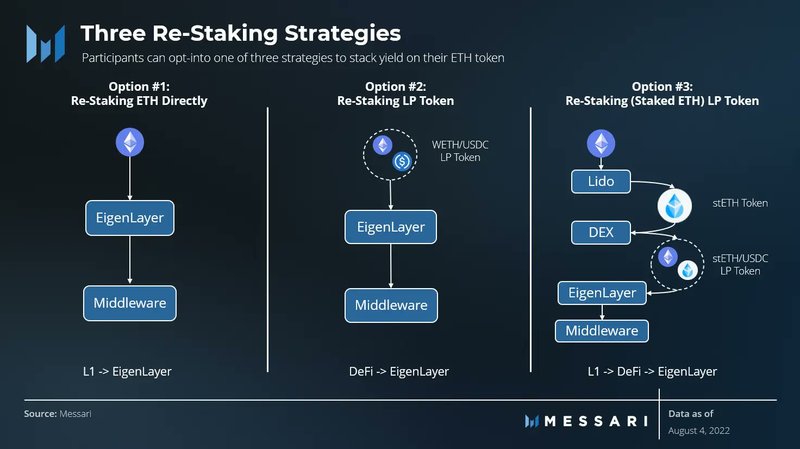
EigenLayer V2 shifts Ethereum restaking from a passive yield layer to an active infrastructure market. The core mechanic is simple: stakers lock ETH or liquid staking tokens (LSTs) into EigenLayer’s smart contracts, creating a pool of shared security that other protocols can rent.
Actively Validated Services (AVSs) are the demand side. Instead of building their own validator networks from scratch, new protocols deploy AVSs on EigenLayer. These services require validators to perform specific cryptographic tasks—such as data availability, cross-chain messaging, or oracle verification—using their restaked stake.
This model solves a critical bottleneck. Historically, launching a secure blockchain required thousands of validators and months of capital expenditure. With AVSs, a protocol can launch with a fraction of the validator count, leveraging the existing Ethereum staker base. This "shared security" dramatically lowers the barrier to entry for new decentralized applications.
For stakers, this creates a new revenue stream. Validators earn yield not just from Ethereum consensus rewards, but from AVS-specific fees. However, this comes with increased risk. If a validator fails to perform its AVS duties, it faces slashing penalties on the restaked portion of its capital.
The ecosystem is evolving rapidly. As more AVSs launch, the total value secured by EigenLayer grows, making Ethereum’s base layer more valuable. This creates a feedback loop: more security attracts more protocols, which in turn attracts more stakers seeking higher yields.
Technical analysis of ETH remains relevant here. As restaking demand increases, the supply of available LSTs decreases, potentially reducing sell pressure on Ethereum. Traders should watch the ETH/USDT chart for signs of accumulation patterns driven by staking inflows.
Compare top liquid restaking tokens
Liquid restaking tokens (LRTs) have shifted from experimental DeFi protocols to core infrastructure for Ethereum security. By 2026, the market has consolidated around a few major players, each offering distinct trade-offs between yield complexity, risk exposure, and ease of use. Understanding the differences between Ether.fi, Renzo, and Symbiotic is essential for allocating capital effectively.
The choice of LRT often depends on whether you prioritize simple ETH yield, exposure to specific AVSs, or flexible withdrawal mechanisms. Below is a side-by-side comparison of the leading protocols to help you identify the right fit for your strategy.
| Protocol | TVL Rank | Primary Yield Source | Risk Profile | Withdrawal Method |
|---|---|---|---|---|
| Ether.fi | 1 | ETH Staking + AVS | Moderate | Instant via eETH |
| Renzo | 2 | ETH Staking + Restaking | Moderate-High | Instant via ezETH |
| Symbiotic | 3 | Flexible Asset Staking | High (Customizable) | Variable by asset |
| Kelp DAO | 4 | ETH Staking + RSETH | Moderate | Instant via rSETH |
| Karak | 5 | AVS Integration | High (Newer) | Protocol Dependent |
Slashing risks and cascade exposure
Restaking amplifies yield by sharing security, but it also concentrates risk. When a validator acting as an AVS operator misbehaves, the penalty is not isolated to a single protocol. The slashing mechanism targets the underlying staked ETH, which is often secured across multiple layers simultaneously.
This creates a cascade effect. A single malicious act can trigger penalties on all services relying on that validator’s stake. For example, if an operator running both a data availability layer and a decentralized oracle network is slashed, the penalty applies to the total restaked amount. This interconnectedness means that one failure can impact yields and principal across the entire restaking ecosystem.
The risk is particularly acute during periods of high network activity or when new services launch with less-tested code. As EigenLayer V2 integrates more complex services, the attack surface expands. Validators must carefully vet the AVSs they support to avoid exposing their entire stake to a single point of failure.
Understanding this risk requires looking at the total value secured by each service. Operators should monitor the health and security audits of every service they restake on. Ignoring the potential for cascading slashing events is a gamble that can erase months of yield in a single transaction.
Bitcoin restaking and cross-chain yield
Bitcoin restaking has emerged as the primary vector for expanding yield beyond Ethereum’s ecosystem. Protocols like Babylon allow holders to secure other networks while keeping their BTC in custody, effectively turning dormant hash power into active cryptographic collateral. This shift introduces a new layer of complexity to yield generation, blending Bitcoin’s security model with Ethereum’s composability.
The mechanism works by locking BTC to validate specific services. Unlike traditional staking, where rewards come solely from consensus participation, restaking yields often derive from the fees generated by these secondary networks. However, this dual-layer security model introduces distinct risk vectors, including slashing conditions that can penalize validators for malicious behavior on any of the secured chains.
Market participants are closely watching how liquidity flows between these protocols. As AVS integration matures, the yield differential between native Bitcoin staking and restaked variants will likely dictate capital allocation. Investors must weigh the potential for higher returns against the smart contract and operational risks inherent in cross-chain security models.
| Feature | Bitcoin Restaking |
|---|---|
| Primary Asset | BTC |
| Security Model | Shared with AVS |
| Yield Source | AVS Fees + Staking Rewards |
| Primary Risk | Slashing across chains |
Frequently asked questions about restaking
Can you still mine Ethereum in 2026?
No. Ethereum permanently ended proof-of-work mining in September 2022 with "The Merge." The network now operates entirely on proof-of-stake, meaning no new ETH is created through mining hardware. Instead, investors and validators earn yields by staking ETH or participating in restaking protocols, which offer a more energy-efficient alternative to the old mining model.
Why is Ethereum staking taking so long?
If you are attempting to stake ETH, you may encounter delays due to protocol-defined queues. The Ethereum network uses these queues to manage validator entry and exit, mitigating security risks from sudden, large-scale changes in the total amount of staked ETH. This throttling ensures the network remains stable during periods of high demand or volatility.
What is the primary risk of restaking?
Restaking amplifies both yield and risk through shared security. When you restake ETH to support multiple AVSs, your staked assets become collateral for all those services. If a validator node associated with any of those services is slashed for malicious behavior or technical failure, your restaked ETH is at risk of being penalized. This "common cause failure" is the central trade-off of the restaking model.
No comments yet. Be the first to share your thoughts!