
Restaking 2026: From Hype to Infrastructure
Restaking has completed its transition from a speculative narrative into a foundational layer of Ethereum’s infrastructure. What began as an experimental yield strategy in 2024 has matured into a critical mechanism for securing decentralized networks. By 2026, the focus has shifted entirely from marketing hype to operational reliability, with protocols like EigenLayer V2 and emerging AVS (Actively Validated Services) networks establishing the technical standards for the ecosystem.
The market data reflects this structural shift. Industry projections estimate the restaking platform market will reach $21.8 billion in 2026, growing at a compound annual rate of 31.2% through 2034 [Intel Market Research]. This growth is not driven by new entrants but by the consolidation of existing stakes. EigenLayer’s Total Value Locked (TVL) has stabilized above $15 billion, indicating that early adopters are maintaining positions rather than rotating capital for short-term gains.
This stability underscores the asset’s role as long-term infrastructure. Institutional participants are no longer testing the waters; they are integrating restaking yields into broader portfolio strategies. The infrastructure is now robust enough to support complex security requirements, marking the end of the "wild west" era and the beginning of a regulated, utility-driven phase.
EigenLayer V2 and the AVS Network Boom
Restaking in 2026 has moved beyond simple yield aggregation to become the primary infrastructure layer for decentralized security. The core shift is driven by EigenLayer V2, which refines how staked ETH is allocated across Actively Validated Services (AVS). Instead of treating restaking as a passive income stream, the protocol now functions as a shared security market where capital is actively deployed to validate specific network functions.
An AVS is a distinct service that requires consensus security, such as decentralized oracles, data availability layers, or new blockchain bridges. By restaking, operators provide the computational and economic security these services need without launching separate validator sets. This modularity allows new protocols to bootstrap security from Ethereum’s largest staked asset pool, significantly lowering the barrier to entry for building on decentralized infrastructure.
The proliferation of AVS has created a more complex but efficient ecosystem. Operators can now choose which services to validate, diversifying their risk and reward profiles. For the broader market, this means that restaked capital is no longer idle; it is actively securing the next generation of Web3 applications. This transition from passive staking to active validation is the defining characteristic of restaking in 2026.
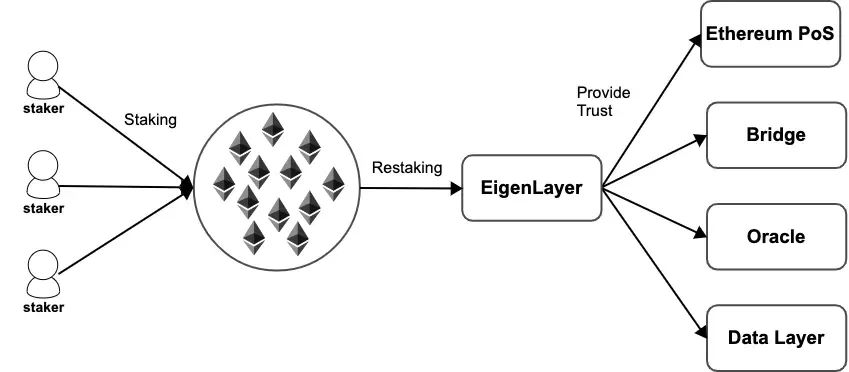
The economic implications are significant. As more AVS launch, the demand for restaked ETH increases, potentially tightening supply and supporting token value. However, this also introduces new risks, such as slashing events across multiple services. Understanding the technical mechanics of AVS is essential for anyone considering restaking as part of their 2026 strategy.
Comparing Top Restaking Protocols in 2026
The restaking landscape in 2026 has consolidated around a few dominant platforms, each offering distinct risk-return profiles and technical architectures. While EigenLayer remains the foundational layer for most Ethereum restaking activity, specialized protocols like EtherFi, Symbiotic, and Kelp DAO have carved out niches by addressing specific limitations in liquidity, composability, and security management.
Evaluating these options requires looking beyond total value locked (TVL) to understand the underlying mechanics. EigenLayer provides the broadest interoperability for Active Validated Services (AVSs), making it the default choice for developers seeking wide exposure. In contrast, Symbiotic focuses on flexible staking configurations that allow for more granular risk management, appealing to institutional actors who require strict control over slashing conditions.
The table below compares the key metrics of the leading restaking protocols as of early 2026. These figures reflect current market conditions and should be verified against live on-chain data before making allocation decisions.
| Protocol | Est. TVL | Primary Focus | Risk Profile |
|---|---|---|---|
| EigenLayer | $12.5B | AVS Interoperability | Medium-High |
| EtherFi | $3.2B | Liquid Staking & LRTs | Medium |
| Symbiotic | $1.8B | Flexible Staking Config | Low-Medium |
| Kelp DAO | $900M | Liquid Restaking Tokens | Medium |
For investors tracking the broader market impact, the performance of the underlying assets remains a critical indicator. The following chart illustrates the recent price action of Ethereum, which serves as the primary collateral for most restaking positions.
Navigating Restaking Security Risks
Restaking amplifies yield potential, but it simultaneously concentrates risk. In 2026, the primary threat to capital is not market volatility, but smart contract vulnerabilities and slashing events. When you restake, you are not just securing a single chain; you are providing security to multiple Active Verifiable Services (AVSs). This creates a complex web of dependencies where a failure in one protocol can trigger penalties across your entire portfolio.
Slashing remains the most immediate danger. If an operator you have delegated to behaves maliciously or fails to perform their duties, the protocol can penalize your stake. Unlike traditional staking, where penalties are often capped or proportional, restaking slashing can be severe, potentially wiping out a significant portion of your principal if the underlying AVS contract has bugs or if the operator is compromised. The interconnectivity of EigenLayer V2 and other restaking networks means that a vulnerability in one layer can cascade, affecting assets secured across multiple services.
Due diligence is no longer optional; it is the core of your security strategy. You must audit the smart contracts of the AVSs you choose to support. Look for formal verification reports, audit history from reputable firms, and the maturity of the codebase. Avoid new, unaudited protocols that offer excessively high yields, as these often compensate for high risk. Additionally, monitor the reputation and track record of the operators you delegate to. Their performance directly impacts your exposure to slashing risks.
Warning: Higher yields in restaking often correlate with higher systemic risk. Ensure you understand the slashing conditions of every AVS before committing capital.
The landscape of restaking security is evolving rapidly. As EigenLayer V2 rolls out, new mechanisms for risk management and insurance may emerge, but the fundamental principle remains: you are responsible for verifying the security assumptions you are making. Always prioritize protocol maturity and transparent risk management over short-term yield gains.
Bitcoin Restaking and Cross-Chain Expansion
Restaking is no longer confined to Ethereum. The 2026 landscape sees Bitcoin liquidity flowing into decentralized security through protocols like Babylon, which allows BTC holders to secure other networks without selling their assets. This shift transforms dormant Bitcoin into active infrastructure, bridging the gap between the world’s largest store of value and high-throughput application layers.
Babalon operates by locking BTC in a verification layer that validates the security of active validator sets (AVS) across multiple chains. Unlike traditional liquid staking, which issues a derivative token representing the asset, restaking keeps the underlying BTC locked while generating security credits for other protocols. This mechanism addresses the "Bitcoin trilemma" by allowing the network to contribute to ecosystem growth without fragmenting its hash rate or liquidity.
As cross-chain activity intensifies, the demand for Bitcoin-backed security grows. Protocols leveraging this infrastructure enable lower transaction costs and faster finality for applications built on non-Ethereum chains. The integration of Bitcoin’s economic security into broader DeFi markets marks a structural change in how capital is allocated and secured across the blockchain ecosystem.
No comments yet. Be the first to share your thoughts!