
What restaking 2026 actually means
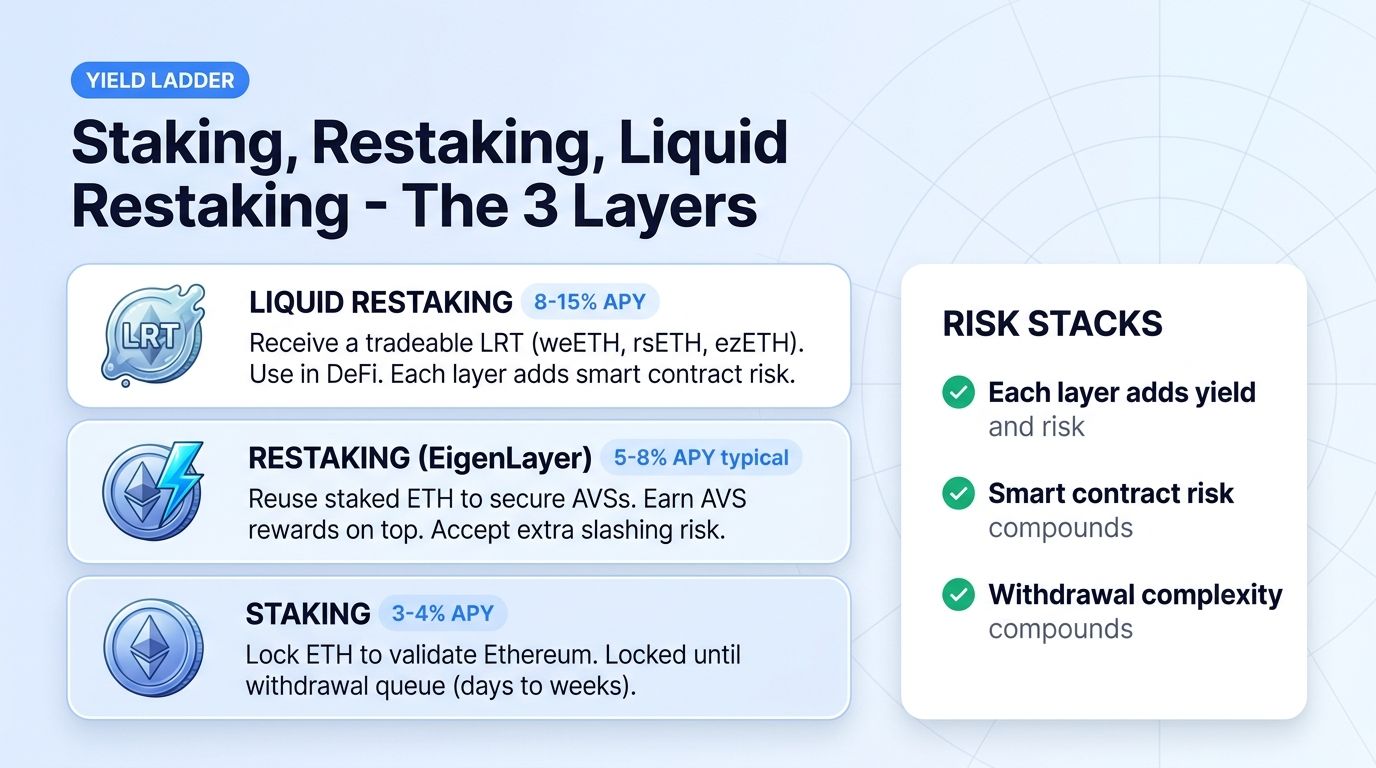
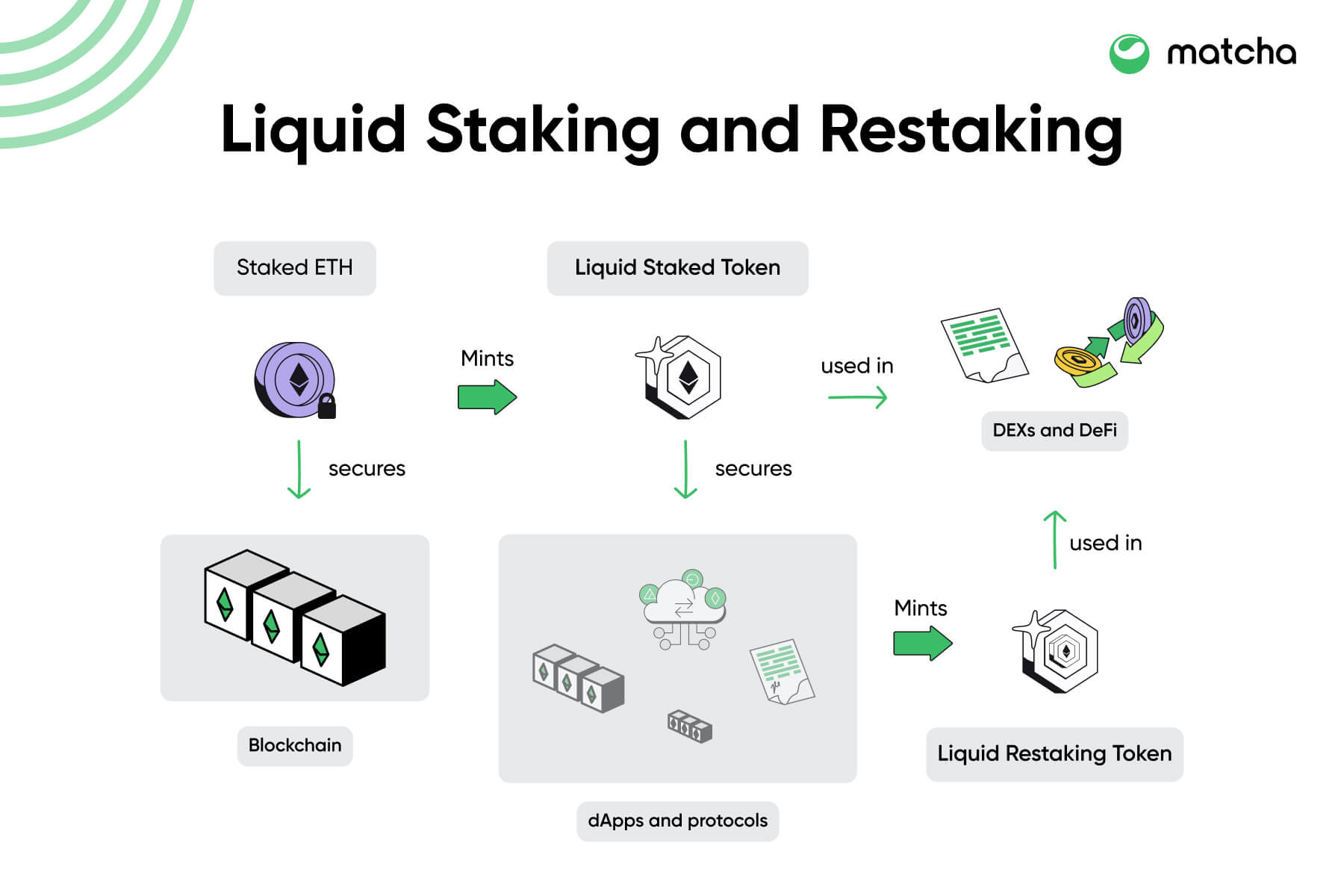
Restaking is the mechanism that allows Ethereum stakers to reuse their already-staked ETH to secure additional decentralized services, known as Actively Validated Services (AVSs). Instead of locking capital for a single purpose—validating the Ethereum mainnet—stakers can delegate that same security to oracles, bridges, or new blockchain networks. This creates a shared security model where the economic weight of Ethereum is leveraged to protect emerging infrastructure.
The primary driver for this shift is yield. By securing multiple services simultaneously, stakers can earn additional rewards on top of their base Ethereum staking returns. As noted in recent market analyses, this "double-dipping" of security has become a central narrative for capital efficiency in the 2026 cycle. Protocols like EigenLayer have pioneered this model, allowing the community to bootstrap security for new protocols without requiring them to build their own validator sets from scratch.
However, this efficiency comes with significant risk. The core mechanic introduces correlated slashing: if a staker’s ETH is slashed for violating the rules of one AVS, the penalty applies to the entire staked amount, including the portion securing Ethereum itself. This concentration of risk means that a failure in a less-established AVS can directly impact the security and rewards of the base Ethereum network. Stakers must carefully assess the smart contract risk and economic incentives of each AVS they support.
This dynamic positions restaking as a double-edged sword for Ethereum’s scalability. It accelerates the deployment of Layer 2 solutions and decentralized infrastructure by providing immediate, robust security. Yet, it also ties the fate of numerous experimental protocols to the stability of the Ethereum mainnet. Understanding this interdependence is critical for anyone evaluating the risk-reward profile of restaking strategies in the current market.
Comparing the top restaking protocols
The restaking landscape in 2026 has consolidated around five primary protocols, each offering distinct architectural approaches to securing additional networks. While EigenLayer remains the dominant force by total value locked (TVL), alternatives like Symbiotic and EtherFi have carved out specific niches through permissionless activation and liquid restaking tokens (LRTs), respectively. Selecting a protocol requires evaluating not just yield potential, but the underlying risk model and composability with existing DeFi positions.
The following table compares the key metrics of the leading platforms. Data reflects current market realities as of early 2026, prioritizing official protocol disclosures and primary on-chain data.
| Protocol | TVL (Est.) | Restaking Model | Risk Profile |
|---|---|---|---|
| EigenLayer | $12.4B | Centralized Operator | High (Active Validations) |
| EtherFi | $3.8B | Liquid Restaking (LRT) | Medium (Liquid Exposure) |
| Symbiotic | $1.2B | Permissionless Pools | Medium (Customizable) |
| Kelp DAO | $850M | Liquid Restaking (rlETH) | Medium (Liquid Exposure) |
| Karak | $420M | Intent-Based | Low (Intent Separation) |
EigenLayer continues to set the standard for restaking volume, leveraging its first-mover advantage and deep integration with Ethereum’s validator set. Its model relies on a curated list of operators, which simplifies participation but centralizes risk management. In contrast, Symbiotic differentiates itself by allowing users to define custom restaking pools with flexible slashing conditions, appealing to sophisticated users seeking granular control over their risk exposure.
EtherFi and Kelp DAO offer liquid restaking tokens (LRTs), such as ezETH and rlETH, which maintain liquidity while restaking. This approach reduces the opportunity cost of locking capital but introduces smart contract risk associated with the LRT wrapper. Karak takes a divergent path by using an intent-based architecture, separating the execution of restaking from the settlement layer, which aims to reduce slashing risks through intent-based verification.
When evaluating these options, it is essential to distinguish between the underlying asset yield and the additional restaking yield. The TVL figures above represent the total value secured across all Actively Validated Services (AVSs). Users should note that higher TVL does not necessarily correlate with higher individual yields, as yields are distributed based on participation rates and the specific AVSs chosen. For those prioritizing capital efficiency, LRT protocols like EtherFi may offer better utility, while those seeking maximum yield and are willing to accept higher complexity may prefer EigenLayer’s direct operator model.
The risk of cascading slashing events
The primary danger in restaking is not just the loss of yield, but the amplification of validator penalties across the entire ecosystem. When a validator operator stakes ETH and simultaneously restakes it to secure multiple Actively Validated Services (AVSs), they are pooling their security deposit. This creates a single point of failure where one operational error can trigger penalties across all secured protocols.
Slashing is the mechanism by which the Ethereum protocol penalizes validators for misbehavior, such as double-signing blocks or prolonged downtime. In a standard staking model, the penalty is confined to the staked ETH. However, in a restaking architecture, the same private keys and validator state are used to sign messages for external AVSs. If a validator is slashed on one AVS due to a technical fault or malicious intent, the protocol may require the forfeiture of the entire restaked balance to cover the security breach. This means a single mistake can wipe out the capital allocated to every service the validator supports.
The correlation of risk transforms isolated incidents into systemic threats. As noted in 2026 market analyses, restaking enables staked assets to secure multiple systems simultaneously, which increases efficiency but also concentrates vulnerability. If a major AVS suffers a breach or a validator operator is found to be acting maliciously, the resulting slashing event does not just affect one protocol. It ripples through the shared security layer, potentially forcing liquidations or penalties on other protocols that relied on that same validator set. This interconnectedness means that the health of one AVS is directly tied to the operational integrity of every other AVS sharing its security.
Warning: Restaking correlates risk. A slashing event on one AVS can penalize the validator's entire restaked balance.
Investors must recognize that yield from restaking is not free money; it is compensation for accepting this heightened, correlated risk. The potential for cascading losses means that the security of the entire restaking ecosystem is only as strong as its weakest validator operator. This reality underscores the importance of choosing AVSs with robust technical audits and clear slashing mitigation strategies.
EigenLayer vs Decentralized Alternatives
EigenLayer remains the dominant force in restaking, but its governance structure presents a distinct contrast to emerging competitors. While EigenLayer offers deep liquidity and established infrastructure, its model relies on a more centralized governance approach. This centralization can streamline decision-making but introduces single points of failure that many institutional investors scrutinize closely.
Symbiotic emerged as the first fully permissionless restaking protocol on Ethereum mainnet, offering a radically different architecture. By removing permissioned gatekeepers, Symbiotic allows any operator to participate without prior approval. This openness reduces the risk of coordinated governance attacks but shifts security responsibility more heavily onto individual stakers. The trade-off is clear: EigenLayer prioritizes ease of use and established yield, while Symbiotic prioritizes censorship resistance and decentralized control.
| Feature | EigenLayer | Symbiotic |
|---|---|---|
| Governance | Centralized | Permissionless |
| Operator Entry | Curated | Open |
| Primary Risk | Governance attack | Operator fragmentation |
The choice between these models depends on your risk tolerance. If you prioritize yield stability and established track records, EigenLayer’s centralized model may feel safer. If you believe in the long-term value of decentralized trust minimization, Symbiotic’s permissionless approach offers a compelling alternative. Both protocols are critical to Ethereum’s scalability roadmap, but they serve different philosophical and practical needs.
Managing Restaking Exposure in 2026
The liquid-staking category holds $39.432 billion in total value locked as of May 2026, with 7-day fees reaching $23.03 million across tracked protocols (CoinLaw). This scale amplifies systemic risk: a single slashing event on a popular Actively Validated Service (AVS) can cascade through multiple restaked assets. Diversification is no longer optional; it is a structural requirement for capital preservation.
Do not concentrate restaked ETH on a single AVS. Spread exposure across 3-5 services with uncorrelated risk profiles, such as separate oracles, data availability layers, and sequencers. This ensures that a failure in one subsystem does not trigger simultaneous slashing across your entire position.
Review the smart contract logic for each AVS before depositing. Prioritize protocols with formal verification audits and a history of transparent bug bounty programs. Avoid AVSs with vague or overly broad slashing conditions that could penalize validators for minor network latencies.

Track governance proposals that adjust reward rates or add new AVSs. Sudden changes in incentive structures can signal a shift in protocol strategy or a drop in demand. Use this data to rebalance your exposure before yields collapse or risk increases.
| Feature | Benefit |
|---|---|
| Uncorrelated AVSs | Limits slashing contagion |
| Formal Audits | Reduces smart contract risk |
| Governance Tracking | Enables proactive rebalancing |
Frequently asked questions about restaking
Restaking amplifies yield by reusing staked assets to secure additional network services, such as oracles or bridges. While this mechanism can double crypto yield potential, it introduces concentrated risk. If a protocol fails, the underlying staked assets face potential slashing. Understanding these mechanics is essential for managing capital in 2026.
How does restaking differ from traditional staking?
Traditional staking locks assets to secure a single blockchain’s consensus layer. Restaking reuses those same assets to provide security to multiple secondary protocols simultaneously. This capital efficiency allows validators to earn multiple yield streams from a single position. However, it also means a single slashing event could penalize the validator across all secured protocols.
What are the primary risks of restaking in 2026?
The main risk is correlated slashing. If a restaked service like an oracle or bridge is compromised, the Ethereum validator securing it may be slashed. This creates a contagion effect where one failure impacts the entire restaked position. Additionally, smart contract risks in EigenLayer and its alternatives remain a concern, as code audits cannot eliminate all vulnerabilities.
Is restaking still viable with current market conditions?
Restaking remains a significant component of Ethereum’s scalability roadmap, with substantial Total Value Locked (TVL) in EigenLayer and emerging alternatives. While yields have normalized from 2024 peaks, they still offer attractive returns compared to traditional staking. Investors should monitor protocol-specific metrics and slashing history rather than chasing high APYs.
Note: Chart reflects general ETH market trends. Restaking yields are protocol-specific and subject to change.
No comments yet. Be the first to share your thoughts!