
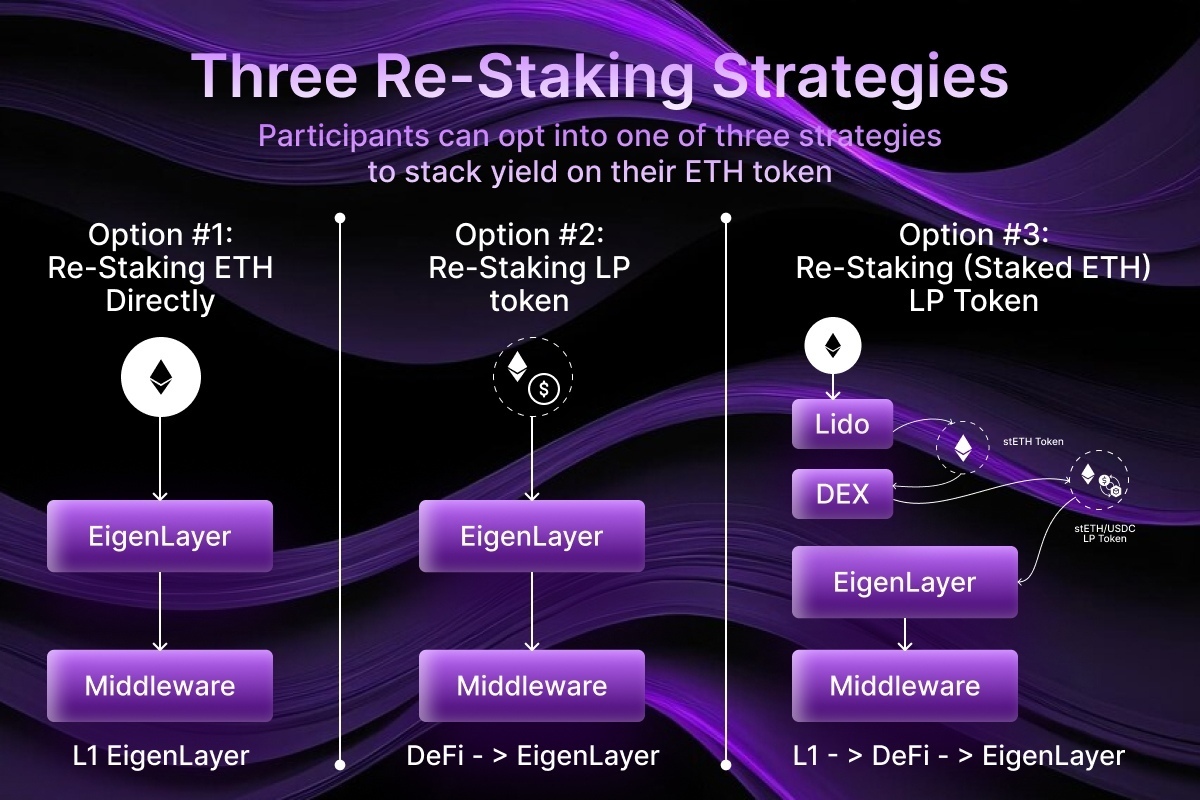
How restaking mechanics work in 2026
Restaking has evolved from a niche yield strategy into a structural pillar of Ethereum’s security model. Unlike the 2023–2024 period, where protocols competed for generic liquidity, the 2026 landscape is defined by specialized security services. Staked ETH now acts as a reusable security primitive, allowing validators to secure multiple networks simultaneously without locking additional capital.
The core mechanic remains simple but carries complex implications. When you stake ETH, you receive liquid staking tokens (LSTs). Restaking allows you to deposit these LSTs into a protocol like EigenLayer, which then delegates that security to Actively Validated Services (AVSs). These AVSs range from oracle networks to bridge validators, each requiring a slice of Ethereum’s consensus power.
This shift introduces a "security premium" on top of the base yield. As of March 2026, solo staking offers approximately 2.8–3.2% base yield. Restaking adds value by monetizing this security for third-party services, but it also concentrates risk. Validators are now exposed to slashing conditions across multiple AVSs, making the mechanics of restaking less about passive income and more about active risk management.
EigenLayer V2 and the Evolution of AVS
EigenLayer V2 is shifting restaking from a beta experiment to a structured financial infrastructure. The upgrade refines how Active Verification Services (AVS) interact with the Ethereum network, specifically targeting the friction points that limited operator participation in earlier phases. By standardizing the integration layer, V2 reduces the technical overhead required to launch new verification services, allowing capital to flow more efficiently toward protocols that need shared security.
The core mechanism remains the same: validators stake ETH to secure Ethereum, then "restake" that same capital to back other networks. However, V2 introduces stricter governance and clearer slashing conditions. In the previous beta, the ambiguity around what constituted a malicious act often led to conservative operator behavior. V2 aims to resolve this by defining precise fault proofs, ensuring that penalties are applied only when specific, verifiable failures occur. This clarity is critical for attracting institutional capital that cannot tolerate regulatory or operational uncertainty.
For operators, the change is a double-edged sword. The potential yield from securing multiple AVSs remains high, but the risk of slashing is now more defined and potentially more severe. Operators must carefully audit the smart contracts of each AVS they support, as a single vulnerability in a downstream protocol could trigger a penalty on their entire restaked position. This dynamic forces a more professionalized approach to node operation, where security audits and risk management are as important as hardware performance.
The evolution of AVS in 2026 is less about finding new use cases and more about hardening the existing ones. As the ecosystem matures, the focus is shifting from speculative yield farming to sustainable, long-term security models. This transition is essential for restaking to maintain its position as a significant pillar of Ethereum's economic layer, rather than a temporary liquidity anomaly.
Top liquid restaking tokens compared
Choosing between liquid restaking tokens (LRTs) requires balancing yield potential against structural complexity. As the restaking ecosystem matures in 2026, the market has consolidated around three primary players: Ether.fi, Renzo, and Kelp DAO. Each protocol offers a distinct risk-reward profile based on its underlying asset mechanics, yield composition, and exposure to Active Validator Service (AVS) slashing.
Ether.fi remains the largest LRT by total value locked, leveraging its native eETH token to capture both Ethereum staking rewards and restaking yield. Its model is heavily integrated with EigenLayer’s ecosystem, meaning higher potential yields but also direct exposure to AVS-specific slashing risks. Renzo, by contrast, uses ezETH, which employs a dynamic hedging strategy to stabilize returns. This approach aims to reduce volatility for users seeking predictable yields, though it may cap upside during peak AVS demand periods. Kelp DAO’s rETH operates as a more traditional staking derivative, focusing primarily on Ethereum consensus rewards with optional restaking layers. Its simpler structure reduces complexity risk but offers lower composite yields compared to its peers.
| Protocol | Underlying Asset | Primary Yield Source | Primary Risk Factor |
|---|---|---|---|
| Ether.fi | eETH | ETH Staking + AVS Restaking | AVS Slashing Exposure |
| Renzo | ezETH | Hedged Staking + AVS Yield | Hedging Strategy Failure |
| Kelp DAO | rETH | ETH Staking + Optional Restaking | Lower Composite Yields |
The decision ultimately hinges on your risk tolerance. If you prioritize maximum yield and can withstand potential slashing events, Ether.fi’s direct exposure offers the highest upside. For those seeking stability, Renzo’s hedged model provides a middle ground. Kelp DAO suits conservative investors who prefer minimal complexity and lower, more predictable returns. Always review the latest AVS requirements and protocol updates, as the risk landscape shifts rapidly with new service launches.
Where the real risks live
Restaking transforms Ethereum’s security into a shared resource, but this efficiency comes with concentrated danger. When you restake, you are not just securing one protocol; you are potentially exposing your assets to the failure modes of multiple Active Verification Services (AVSs). The yield you earn is often a direct compensation for accepting this layered risk, and the structural complexity of 2026’s ecosystem means that a failure in one niche AVS can ripple through the entire restaking market.
Smart contract and dependency risk
Every AVS built on EigenLayer introduces new smart contract code that your restaked ETH must support. While the core EigenLayer contracts are heavily audited, individual AVS implementations vary widely in maturity. If an AVS has a vulnerability, your restaked ETH is on the line. This is not just theoretical; early restaking deployments have already demonstrated that code bugs in secondary protocols can lead to significant losses for stakers who assumed their ETH was "safe" because it was secured by Ethereum’s base layer.
Slashing: The price of misbehavior
Slashing is the mechanism that punishes validators for malicious behavior or downtime. In a restaking context, slashing events are more complex because a single validator might be securing multiple services. If you are slashed for failing to perform duties for one AVS, your entire restaked position can be penalized. This creates a "guilt by association" scenario where the risk of one poorly managed AVS can drain your yield or principal. The 2026 landscape sees more sophisticated slashing conditions, making it harder for individual stakers to monitor every service they support.
Liquidity fragmentation and exit bottlenecks
As restaked assets grow, liquidity can become fragmented across dozens of AVSs. This makes it difficult to exit positions quickly during market stress. If many stakers try to unstake simultaneously, the queue can back up, leading to delayed withdrawals and potential slippage. This fragmentation also means that the value of your restaked ETH is tied to the health of specific, often illiquid, AVS tokens. A collapse in one niche AVS can trigger a broader sell-off, dragging down the entire restaking sector regardless of Ethereum’s underlying health.
Frequently asked questions about restaking
Can you still mine Ethereum in 2026?
No. Ethereum completed its transition from proof of work to proof of stake in September 2022. Mining hardware cannot generate ETH today; participation requires staking at least 32 ETH or using liquid staking derivatives.
Will Ethereum rebound in 2026?
Market performance remains unpredictable. As of March 2026, solo staking yields sit at 2.8–3.2% base, with restaking adding a specialized security premium. Yields reflect structural shifts in demand rather than speculative price action.
When did ETH go proof of stake?
Ethereum finalized its transition to proof of stake on September 15, 2022, via "The Merge." This replaced energy-intensive mining with validator-based consensus, fundamentally altering the network's security model and yield mechanisms.
No comments yet. Be the first to share your thoughts!