
In early 2026, the quest for optimal yields in Celestia blobspace restaking has sharpened the EigenLayer vs Symbiotic debate among DA layer enthusiasts. With Celestia’s modular architecture driving demand for secure, high-throughput data availability, restaking protocols promise to amplify returns by leveraging Ethereum’s security. Yet, as TVLs shift and incentives evolve, choosing between EigenLayer’s steadfast dominance and Symbiotic’s agile flexibility demands rigorous analysis. This piece dissects their mechanics, risks, and synergies for blobspace yield optimization.

Celestia vs EigenLayer vs Symbiotic vs Polygon Avail: Modular DA & Restaking Comparison for Blobspace Yield Optimization (2026) 🚀
| Key Metric | Celestia 🪐 | EigenLayer ⚡ | Symbiotic 🌿 | Polygon Avail 🎯 |
|---|---|---|---|---|
| Type | Pioneering Modular DA Layer 💡 | Restaking Protocol + EigenDA 🔄 | Network-Agnostic Restaking 🌐 | Modular DA Layer (Polygon Ecosystem) 🛡️ |
| Restaking TVL (Early 2026) | N/A (DA Focus) | $18B+ 💰 | $565M 📉 | N/A (DA Focus) |
| Market Position | First Modular DA Leader | Dominant Restaking 🥇 | Gaining Traction but Volatile 🥈 | Competitive DA Challenger |
| Blobspace Yield Optimization Risks | Centralization & Scaling ⚠️ | Low: Stable TVL & ETH Security ✅ | High: TVL Decline & Retention Issues 🚨 | Ecosystem Dependency & Competition ⚠️ |
| Synergies with Celestia Blobspace | Native Blobspace Baseline 🔗 | Robust ETH-Aligned Security for DA 🔒 | Flexible ERC-20 Yields & Customization 🚀 | Alternative DA Integration Options 🔄 |
| 2026 Projections | Market Leader in DA 📈 | TVL >$25B, Hybrid Security King 🏆 | Rebound Potential to $2B+ ❓ | Steady Niche Growth 📊 |
EigenLayer’s Foundation in Ethereum-Aligned Restaking
EigenLayer, the restaking pioneer, commands a commanding TVL surpassing $18 billion as of mid-2025, a testament to its Ethereum PoS integration. By enabling stakers to secure Actively Validated Services (AVSs) alongside core staking rewards, it creates layered yields ideal for Celestia blobspace providers. Native ETH and select Liquid Staking Tokens (LSTs) form its backbone, ensuring predictable security without the fragmentation of broader asset support.
For Celestia integrations, EigenLayer’s proven track record shines. Blobspace operators can restake to bolster data availability sampling, drawing from Ethereum’s vast validator pool. This setup minimizes slashing risks through correlated fault detection, appealing to those prioritizing capital preservation over speculative alpha. Reflecting on its trajectory, EigenLayer’s growth reflects a market favoring reliability; its AVS uptime has consistently exceeded 99.5%, per recent audits.
Yield optimization here hinges on incentive alignment. Stakers earn base ETH rewards plus AVS points, convertible to EIGEN tokens post-airdrop. In Celestia’s ecosystem, this translates to compounded APYs often hitting 15-20% for blobspace tasks, outpacing vanilla staking amid modular chain expansion.
Symbiotic’s Modular Edge and Recent Headwinds
Symbiotic counters with a network-agnostic framework, accepting diverse ERC-20s like stETH and beyond. This breadth suits yield optimizers targeting Celestia blobspace restaking, allowing curated vaults for higher-risk, higher-reward DA services. Its modular vaults enable fine-tuned collateral and slashing conditions, potentially unlocking superior returns in niche blobspace markets.
However, volatility tempers enthusiasm. After peaking at $2.5 billion TVL in 2024, Symbiotic’s deposits dwindled to $565 million by early 2026, signaling post-incentive flight. This mirrors broader restaking fatigue, where unsustainable airdrop farming erodes long-term viability. For Celestia users, Symbiotic’s flexibility shines in multi-asset strategies but introduces correlation risks across non-ETH collateral.
Delving deeper, Symbiotic’s permissionless AVS deployment fosters innovation, like experimental blobspace verifiers. Yet, its yield potential, while theoretically higher at 20-25% APY peaks, fluctuates with vault adoption. Analysts note that without EigenLayer’s Ethereum gravity, Symbiotic struggles to retain sophisticated capital.
Strategic Implications for Celestia Blobspace Providers
Navigating DA layers restaking protocols, Celestia operators must weigh trade-offs. EigenLayer offers bedrock stability, its $18 billion TVL insulating against market drawdowns. Symbiotic, conversely, invites symbiotic restaking Celestia plays via asset diversification, capturing alpha from underrepresented blobspace niches.
A reflective lens reveals no outright victor; EigenLayer’s conservatism suits core allocations, while Symbiotic probes the frontiers. Early 2026 data underscores this: EigenLayer’s steady inflows contrast Symbiotic’s recovery efforts, post its $565 million trough. For blobspace yield optimization, due diligence favors monitoring AVS launches and collateral audits.
Consider a provider allocating 70% to EigenLayer for secure DA yields, reserving 30% for Symbiotic’s vaults. This hybrid mitigates risks while chasing blobspace yield optimization. As modular ecosystems mature, such strategies could define 2026 outperformance.
Hybrid allocations demand granular oversight. Providers should track Symbiotic’s vault health metrics, where liquidation thresholds have tightened amid TVL pressures, now hovering at $565 million. EigenLayer’s operator sets, meanwhile, enforce stricter delegation caps, channeling capital toward high-uptime AVSs like those sampling Celestia blobs.
Risks in the Restaking Duopoly
Scrutinizing eigenlayer celestia integration 2026 reveals correlated perils. EigenLayer’s Ethereum tether exposes blobspace stakers to L1 congestion risks, where sequencer delays could cascade into DA sampling faults. Historical data from 2025 outages showed temporary yield dips of 2-3%, yet recovery was swift due to its validator depth.
Symbiotic amplifies these with multi-asset exposure. Non-native collateral invites oracle failures or depegs, as seen in late 2025 when a stETH fluctuation slashed vault yields by 8%. For Celestia operators, this underscores the need for overcollateralization ratios above 150% in symbiotic restaking celestia setups. My view: Symbiotic’s innovation tempts, but its recent retrenchment demands proof of sustained traction before scaling commitments.
Celestia (TIA) Price Prediction 2027-2032
Projections factoring EigenLayer (15-22% APY) vs Symbiotic (18-28% APY) restaking for Celestia blobspace yield optimization, TVL recovery, and modular DA dominance
| Year | Minimum Price (USD) | Average Price (USD) | Maximum Price (USD) | YoY % Change (Avg) |
|---|---|---|---|---|
| 2027 | $10.50 | $16.20 | $25.80 | -10% |
| 2028 | $15.00 | $24.30 | $40.50 | +50% |
| 2029 | $28.00 | $48.60 | $90.00 | +100% |
| 2030 | $40.00 | $65.00 | $120.00 | +34% |
| 2031 | $55.00 | $90.00 | $160.00 | +38% |
| 2032 | $75.00 | $125.00 | $220.00 | +39% |
Price Prediction Summary
Celestia (TIA) shows strong long-term potential with average prices climbing from $16.20 in 2027 to $125 by 2032, fueled by high-yield restaking via EigenLayer and Symbiotic, modular DA adoption, and Ethereum ecosystem synergies. Min/Max ranges account for bearish scenarios (regulatory hurdles, competition from EigenDA/Avail) and bullish cycles (TVL surges, tech upgrades).
Key Factors Affecting Celestia Price
- Restaking yield optimization: EigenLayer’s stable $18B+ TVL (15-22% APY) vs Symbiotic’s flexible 18-28% APY vaults amid TVL rebound
- Modular DA leadership amid competition from Avail and EigenDA
- Ethereum restaking boom driving shared security and capital inflows
- Market cycles with 2028-2029 bull potential post-2026 recovery
- Regulatory clarity on restaking and DA layers
- Technological advancements in blobspace scalability and AVS integrations
Disclaimer: Cryptocurrency price predictions are speculative and based on current market analysis.
Actual prices may vary significantly due to market volatility, regulatory changes, and other factors.
Always do your own research before making investment decisions.
Reflecting on trajectories, EigenLayer’s path evokes equity markets’ blue-chips: steady compounding over hype cycles. Symbiotic, akin to growth stocks, surges on catalysts like new Celestia partnerships but falters without fundamentals. Early 2026 signals a pivot; Symbiotic’s integrations with blobspace verifiers could rebound TVL, yet EigenLayer’s $18 billion fortress remains unassailable for risk-averse allocators.
Yield Optimization Playbook
Practical execution favors phased deployment. Begin with EigenLayer for baseline security, layering Symbiotic exposure post-audit. Monitor Celestia blockspace auctions, where restaked collateral bids increasingly favor EigenLayer’s predictability. Tools like dynamic slashing simulations reveal optimal splits: 65-75% EigenLayer secures 12-18% blended APY, with Symbiotic adding 3-5% alpha in bullish scenarios.
Community forums echo this nuance. Debates on Celestia threads highlight EigenLayer’s edge in sovereign DA rollups, while Symbiotic garners nods for cross-chain blob experiments. As a long-termist, I advocate depth: simulate portfolios via testnets, prioritizing AVS diversity over raw APY chases.
Celestia Technical Analysis Chart
Analysis by Owen Sinclair | Symbol: BINANCE:TIAUSDT | Interval: 1W | Drawings: 7
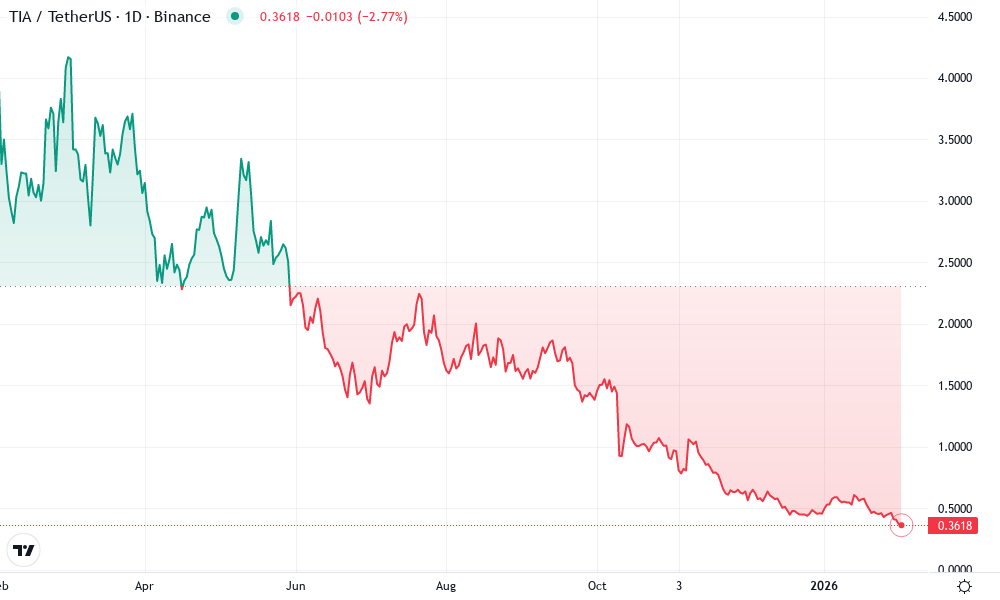
Technical Analysis Summary
To annotate this Celestia (TIAUSDT) chart effectively in my conservative style, begin by drawing a prominent downtrend line connecting the June 2026 swing high near 3,800 to the late December 2026 low around 530, using ‘trend_line’ with red color for bearish emphasis. Add horizontal support at 500 (strong) and resistance at 1,000 (moderate), 2,000 (weak). Mark the recent consolidation as a ‘rectangle’ from mid-November to December 2026 between 500-650. Use ‘horizontal_line’ for key levels, ‘date_price_range’ for accumulation zone late 2026. Place ‘arrow_mark_down’ on high-volume breakdown in October 2026. Add ‘callout’ texts for oversold RSI at 30.51 and MACD bearish divergence. Finally, ‘text’ labels for low-risk entry zone above 500 support with stop below.
Risk Assessment: high
Analysis: Extended downtrend with low RSI but no reversal confirmation; external restaking competition adds macro pressure despite Celestia’s DA fundamentals
Owen Sinclair’s Recommendation: Remain sidelined for now—low risk tolerance favors waiting for higher lows and EigenLayer/Symbiotic stability signals. Long-term accumulate on proven support.
Key Support & Resistance Levels
📈 Support Levels:
-
$500 – Psychological and volume cluster low, aligns with 2026 year-open proximity
strong -
$450 – Absolute downside projection if breakdown, prior micro-low
moderate
📉 Resistance Levels:
-
$1,000 – Recent swing high retest in Nov consolidation
moderate -
$1,500 – Fib 38.2% retrace of major drop, prior resistance zone
weak
Trading Zones (low risk tolerance)
🎯 Entry Zones:
-
$520 – Bounce from strong support at 500 with RSI oversold divergence, low-risk long for fundamental holders
low risk -
$480 – Deeper support test for aggressive dip-buy, only on volume pickup
medium risk
🚪 Exit Zones:
-
$900 – Initial profit target at moderate resistance
💰 profit target -
$450 – Tight stop below strong support to preserve capital
🛡️ stop loss
Technical Indicators Analysis
📊 Volume Analysis:
Pattern: spikes on downside breakdowns, drying up in recent consolidation
Confirms distribution phase mid-year, potential accumulation shift late 2026
📈 MACD Analysis:
Signal: bearish crossover persisting, histogram contracting
Momentum weak but nearing potential bullish divergence near lows
Applied TradingView Drawing Utilities
This chart analysis utilizes the following professional drawing tools:
Disclaimer: This technical analysis by Owen Sinclair is for educational purposes only and should not be considered as financial advice.
Trading involves risk, and you should always do your own research before making investment decisions.
Past performance does not guarantee future results. The analysis reflects the author’s personal methodology and risk tolerance (low).
Visualizing these dynamics clarifies conviction. Charts depict EigenLayer’s resilience amid Symbiotic’s volatility trough, underscoring blobspace providers’ pivot toward proven security. Yet, Symbiotic’s modular vaults plot intriguing uptrends if TVL catalysts materialize, like expanded ERC-20 support for Celestia-native assets.
Forward-looking, 2026’s modular renaissance positions restaking as blobspace’s yield engine. EigenLayer will anchor institutional flows, its Ethereum moat fortifying DA layers against centralization critiques. Symbiotic, if it stabilizes beyond $1 billion TVL, could disrupt with permissionless innovation, redefining celestia blobspace restaking. Providers blending both navigate uncertainty adeptly, harvesting compounded returns in this DA layers restaking protocols arena.
- Anchor 70% in EigenLayer for slashing-resistant DA security.
- Rotate 20% into Symbiotic high-yield vaults quarterly.
- Reserve 10% dry powder for AVS launches.
This disciplined framework, rooted in empirical TVL shifts and audit insights, equips operators for sustained outperformance. The restaking war endures, but informed hybrids prevail.
About the Author