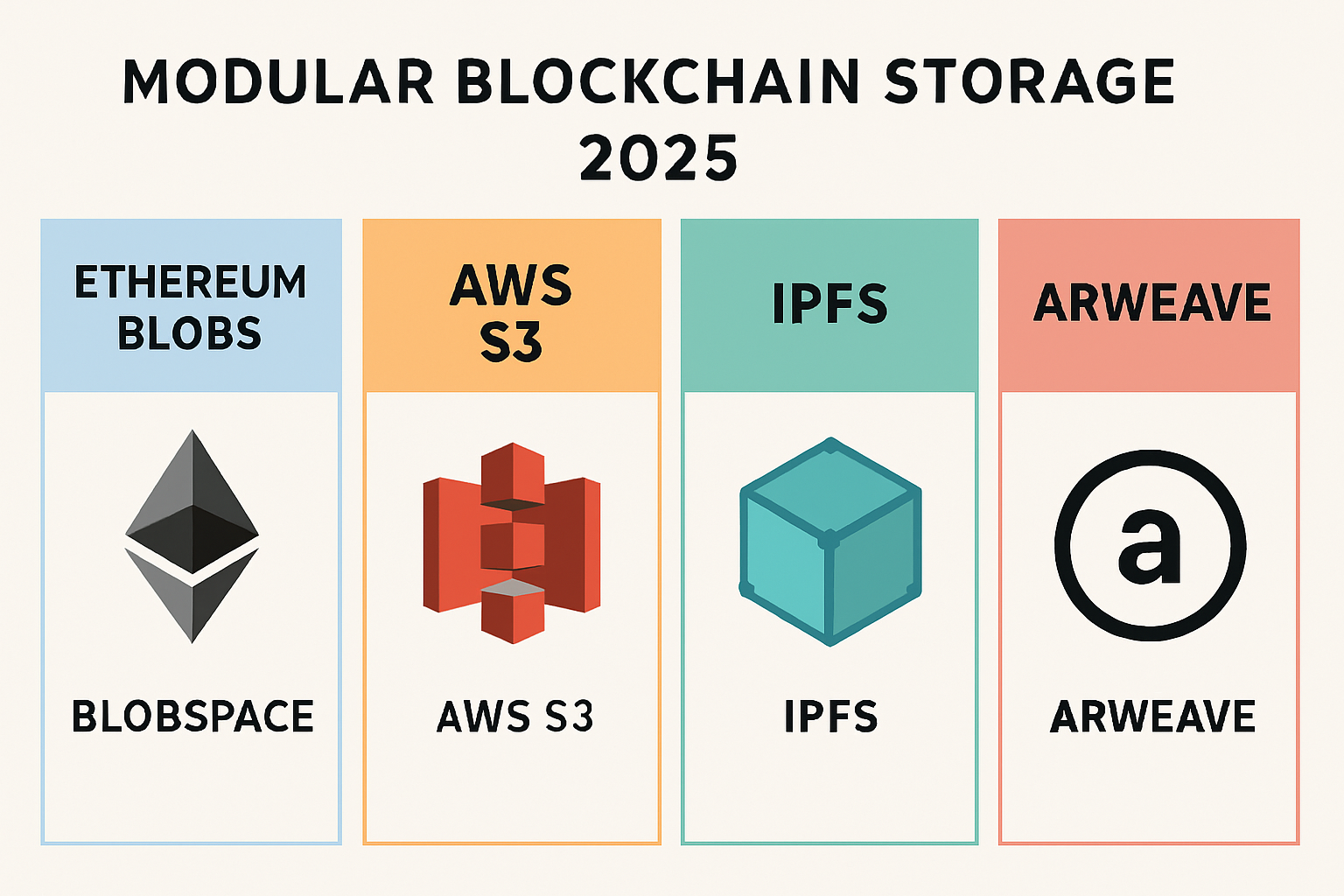
In 2025, the debate over where and how to store critical blockchain data is more relevant than ever. Developers, DAOs, and enterprises are weighing the pros and cons of onchain data availability layers against both centralized cloud giants and decentralized storage networks. With the modular blockchain movement in full swing, understanding how Ethereum Blobspace (EIP-4844 and Danksharding), Amazon Web Services (AWS) S3, InterPlanetary File System (IPFS), and Arweave stack up is crucial for anyone building or investing in the next generation of dApps.

Ethereum Blobspace: The New Standard for Onchain Data Availability
The launch of Ethereum’s Blobspace with EIP-4844 (Dencun upgrade) in March 2024 was a watershed moment for Layer-2s. By dedicating special blob storage space on Ethereum’s base layer, rollups can now post transaction data directly to Ethereum at a fraction of previous costs. The upcoming Pectra upgrade aims to further boost blob throughput, making it even more attractive for high-volume dApps.
This evolution isn’t just about lower fees. It’s about trust-minimized settlement and real-time data availability guarantees that only an onchain solution can provide. Unlike offchain or semi-centralized alternatives, blobspace leverages Ethereum’s robust validator set for censorship resistance and security. For projects prioritizing decentralization and composability, think DeFi protocols or cross-chain bridges, blobspace offers a uniquely compelling middle ground between cost and cryptographic assurance.
AWS S3: Centralized Convenience Meets Web3 Friction
AWS S3 remains the gold standard for scalable cloud storage in traditional tech stacks, but its centralized nature is becoming an increasing concern for Web3 builders. While AWS offers unmatched uptime SLAs, granular access controls, and seamless integration with legacy infrastructure, it comes with trade-offs that are hard to ignore:
- Censorship risk: Data can be altered or removed at the discretion of Amazon or regulatory authorities.
- Lack of native composability: Integrating S3 with smart contracts or decentralized services requires complex bridges or middleware.
- Data sovereignty concerns: Users must trust AWS not just with their files but also with metadata and access patterns.
If your project demands instant scalability without decentralization requirements, say, running a hybrid app backend, AWS still makes sense. But as more protocols embrace full-stack modularity, reliance on centralized clouds is increasingly seen as a liability rather than a feature.
IPFS: Decentralized File Sharing With Persistence Caveats
The InterPlanetary File System (IPFS) has been a favorite among open-source advocates since its inception. In early 2025, IPFS maintained around 23,000 active peers, a testament to its global reach (Source: CoinLaw). Its peer-to-peer architecture enables content-addressable file sharing without central points of failure.
The catch? Data persistence isn’t automatic. Unless you pay for pinning services or incentivize nodes to keep your files available, content can vanish from the network over time. This model works well for distributing static assets like NFT metadata but falls short when you need ironclad guarantees that data will be there tomorrow, or ten years from now.
If you’re comparing blobspace vs IPFS for L2 rollup data or mission-critical records, keep in mind that only onchain solutions like Ethereum’s blobs offer native economic incentives (via ETH fees) to ensure long-term availability as part of protocol consensus.
Arweave: Permanent Storage For A One-Time Fee
Arweave, powered by its blockweave technology, takes decentralization one step further by promising permanent storage through a single upfront payment. This makes it uniquely suited for applications where immutability is non-negotiable, think legal documents or historical archives. In contrast to IPFS’s ongoing pinning fees or AWS’s recurring billing cycles, Arweave users pay once and enjoy perpetual access backed by an ever-growing distributed network (Source: CoinMarketCap Academy).
This permanence has made Arweave especially popular among NFT platforms seeking true digital provenance, and among DA layers experimenting with hybrid approaches that combine blobspace settlement with Arweave archiving for maximum redundancy.
If you want an even deeper dive into why so many L2s are choosing onchain data availability layers over legacy options like AWS or even decentralized file systems like IPFS and Arweave alone, check out our full breakdown here.
Choosing between Ethereum Blobspace, AWS S3, IPFS, and Arweave in 2025 really comes down to your project’s needs for decentralization, permanence, and composability. Let’s unpack the implications for developers, DAOs, and investors navigating the rapidly evolving landscape of modular blockchain infrastructure.
Comparing Core Features: Which Solution Fits Your Use Case?
Each of these four data availability and storage solutions brings a unique philosophy to the table:
- Ethereum Blobspace (EIP-4844 and Danksharding): Onchain, trust-minimized, and deeply integrated with Ethereum’s security guarantees. Ideal for L2 rollups, DA layers, and any dApp that needs verifiable data availability with instant composability.
- AWS S3: Centralized, highly scalable, and developer-friendly, great for traditional web apps or hybrid architectures but falls short on censorship resistance and decentralized access.
- IPFS: Decentralized file sharing with global reach. Fantastic for open data distribution or NFT metadata but requires extra steps (pinning) for long-term persistence.
- Arweave: Decentralized permanent storage with a one-time fee. Perfect for immutable records and digital provenance but less suited to high-frequency transactional data due to cost structure.
Comparison of Data Availability and Storage Solutions in 2025
| Solution | Decentralization | Cost Model | Data Persistence | Composability |
|---|---|---|---|---|
| Ethereum Blobspace (EIP-4844, Danksharding) | Highly decentralized (secured by Ethereum validators) | Fee per blob (variable, paid in ETH) | Short- to medium-term (data available for a fixed period, not permanent) | Native integration with Ethereum dApps and rollups |
| Amazon Web Services (AWS) S3 | Centralized (controlled by AWS) | Pay-as-you-go (recurring fees based on usage) | Persistent as long as you pay (data can be deleted by AWS) | Easily integrates with Web2 and some Web3 apps via APIs |
| InterPlanetary File System (IPFS) | Decentralized (peer-to-peer, ~23,000 peers in 2025) | Free to use, but persistence requires paid pinning services | Not guaranteed (data can disappear unless pinned) | Popular for NFT metadata and dApp assets, but not natively composable with blockchains |
| Arweave | Decentralized (blockweave protocol) | One-time upfront fee for permanent storage | Permanent (data stored forever, immutable) | Seamless integration with dApps, ideal for immutable records and NFTs |
Restaking and Modular DA Layers: A New Era of Yield and Security
The rise of modular blockchains, and especially restaking protocols, has made onchain data availability layers like Ethereum Blobspace more attractive than ever. By leveraging restaking mechanisms (think EigenLayer), validators can secure both execution and data layers simultaneously. This not only increases network security but also unlocks new yield opportunities for stakers willing to support critical infrastructure.
This paradigm shift is fueling innovation in blobspace economics: ETH blob fees are increasingly burned as part of Ethereum’s fee market dynamics, directly tying protocol health to network activity. For DAOs or investors seeking sustainable returns alongside robust security guarantees, this is a game-changer compared to the pay-as-you-go or subscription models of AWS S3 or IPFS pinning services.
What Does This Mean For dApps In 2025?
The modular revolution means developers can now mix-and-match their stack based on precise requirements:
- Sensitive DeFi transactions? Post state roots or proofs directly into Ethereum Blobspace for maximum trust-minimization.
- User-generated content or static files? Distribute via IPFS for efficiency, just be sure to arrange persistent pinning if uptime matters.
- Permanence above all else? Archive on Arweave so your data outlives any single node or provider.
- Burst scalability without decentralization? AWS S3 remains unbeatable when trust assumptions are acceptable.
The result? We’re seeing a new breed of dApps that combine the best features of each system: fast settlement via blobspace, open distribution via IPFS, archiving on Arweave, and fallback redundancy in centralized clouds when needed. The real winners are projects that understand these trade-offs deeply and architect their stack accordingly. a0For an even deeper technical comparison, including tips on maximizing blobspace restaking benefits, see our resource at Blobspace Markets.
If you’re building in Web3 today, or simply looking to maximize the longevity and resilience of your project’s critical data, the best approach is often not picking just one solution but orchestrating them together. The future is modular; make sure your storage strategy is too.
About the Author