

Celestia’s meteoric rise in 2025 is no accident. As the modular blockchain movement matures, Celestia’s blobspace growth has become the backbone for a new wave of multi-rollup architectures. With Celestia (TIA) currently trading at $0.6326, the network’s real-world momentum is reflected not just in price but in adoption metrics, developer activity, and ecosystem expansion. Let’s break down how Celestia’s unique approach to data availability and modularity is powering the next generation of decentralized applications.
Blobspace: The Fuel for Multi-Rollup Modular Blockchains
At its core, Celestia delivers what monolithic blockchains can’t: scalable, dedicated data availability (DA) for rollups. By providing cheap and abundant blobspace, Celestia lets rollups post large transaction datasets ("blobs") without bloating consensus layers or driving up costs. This separation of concerns means that execution environments can be customized and optimized off-chain, while Celestia handles the heavy lifting of data storage and verification.
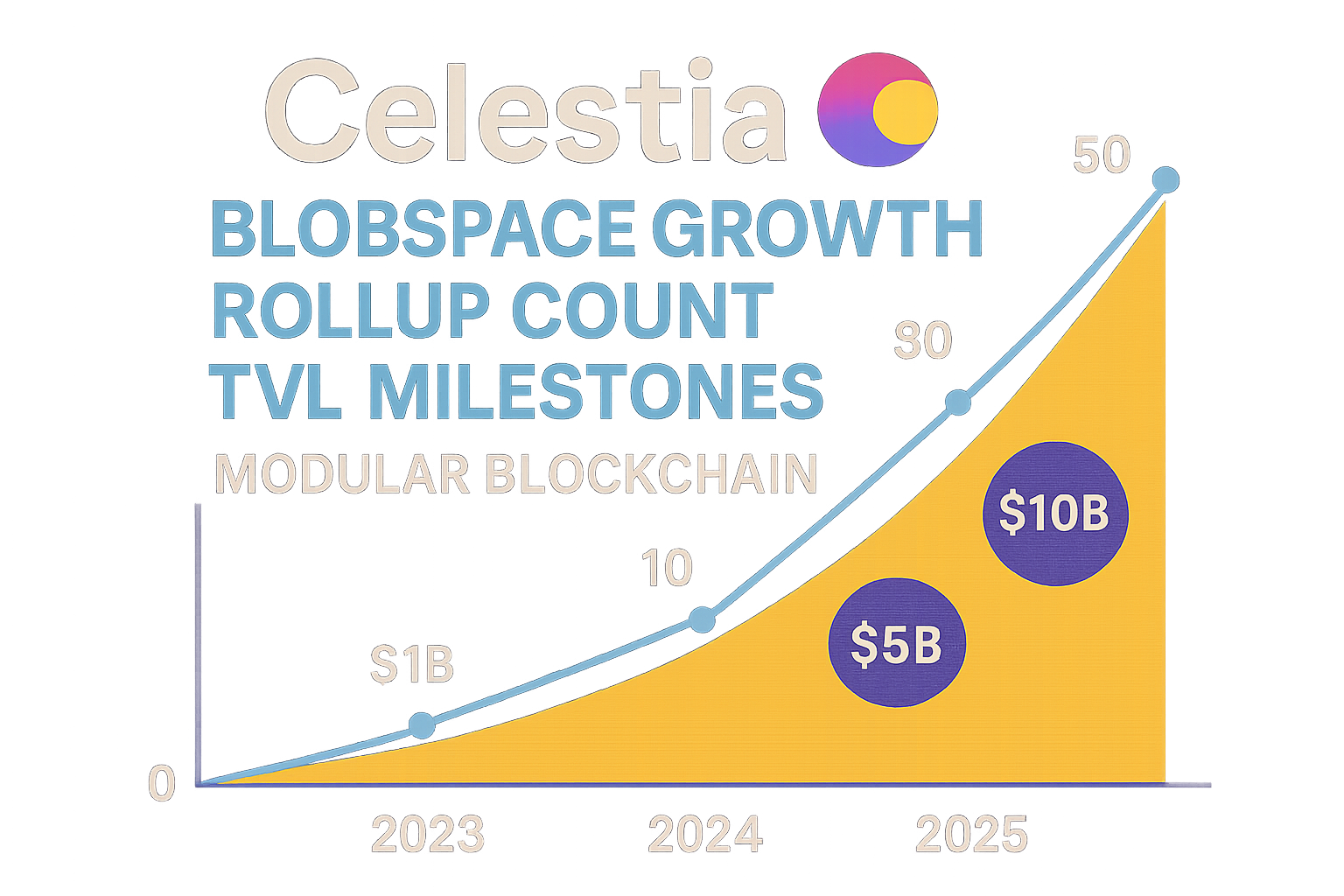
The impact? In 2025, over 50 rollups are actively leveraging Celestia’s DA layer, with a total value locked (TVL) nearing $500 million. Upgrades like Ginger have turbocharged throughput and reduced block times, making it practical for high-frequency applications, from DeFi to gaming, to thrive in a modular context.
“Celestia’s blobspace surge isn’t just about bigger blocks, it’s about unleashing a new design space for permissionless innovation. ”
This technical leap is underpinned by Data Availability Sampling (DAS), which empowers even lightweight nodes to verify that all posted data is truly available, without needing to download entire blocks. It’s a game-changer for decentralization and security at scale.
Decoupling Execution: Why Modular Matters in 2025
The genius of Celestia lies in its radical decoupling of consensus, execution, and DA. Unlike legacy chains where every validator must process every transaction, Celestia enables sovereign rollups, each with their own rulesets, to launch without bootstrapping their own validator sets. This unlocks rapid experimentation with new virtual machines, privacy tech, or application-specific logic.
This modular paradigm has turned Celestia into what many are calling the "AWS of blockspace. " Developers can deploy custom chains as easily as spinning up cloud instances, except here, the resource being provisioned is verifiable on-chain data availability rather than raw compute power.
- Lower fees: Rollups pay only for the blobspace they use, not for global consensus overhead.
- Sovereignty: Projects aren’t beholden to upstream protocol politics or upgrade cycles.
- Ecosystem synergy: Integration with Ethereum via Blobstream allows seamless cross-chain composability.
If you want to dive deeper into how namespaced Merkle trees enable this kind of scalable rollup deployment on Celestia, check out this comprehensive guide: How Namespaced Merkle Trees Power Scalable Modular Rollups on Celestia A pivotal milestone this year was the rollout of Blobstream, an integration that lets Ethereum rollups post transaction data directly onto Celestia’s high-throughput DA layer. This move slashes costs for optimistic and zk-rollups building on Ethereum while maintaining robust security guarantees. The result? A Cambrian explosion of multi-chain applications that leverage both Ethereum’s liquidity and Celestia’s scalable infrastructure. This cross-ecosystem synergy isn’t limited to Ethereum alone, Celestia has also seen integrations with projects from NEAR to ATOM zones, all seeking scalable DA solutions as their user bases grow. As more protocols adopt modular frameworks, expect further innovation at the intersection of blobspace economics and cross-chain interoperability. Professional TIA Price Forecast Based on Modular Blockchain Growth and Market Trends Celestia (TIA) is positioned for strong growth through 2031, driven by its leadership in modular blockchain data availability. While the path will include periods of volatility and competition from other DA solutions, TIA’s expanding ecosystem, institutional integration, and technological innovation support a progressive price outlook. Investors should expect both bullish and bearish cycles, with average prices likely to trend upward as modular blockchains reshape the crypto landscape. Disclaimer: Cryptocurrency price predictions are speculative and based on current market analysis.
Actual prices may vary significantly due to market volatility, regulatory changes, and other factors.
Always do your own research before making investment decisions. Developers and users alike are feeling the ripple effects of Celestia’s blobspace expansion. The cost efficiency and scalability have not only driven TVL to new heights but have also made it viable for smaller teams to launch application-specific rollups without the prohibitive infrastructure costs that previously stifled innovation. This is a fundamental shift: modular blockchains are no longer a theoretical upgrade, but the default choice for ambitious builders in 2025. Let’s not overlook Celestia’s phased airdrop strategy, which has been instrumental in onboarding new participants and incentivizing robust developer engagement. By distributing TIA to both early contributors and active users, Celestia has fostered a sticky, dynamic community that continues to experiment with new DA restaking models and cross-chain primitives. One of the most exciting trends emerging from Celestia’s ecosystem is the rise of DA restaking. By allowing TIA holders to restake their tokens across multiple data availability protocols or rollups, users can maximize yield while contributing to network security. This creates a positive feedback loop: as more capital flows into restaking strategies, blobspace becomes more secure and abundant, further lowering costs for rollups and increasing adoption. The modular architecture also enables sophisticated fee markets for blobspace itself. As demand surges from DeFi protocols, gaming chains, and enterprise applications (including Filecoin’s recent integration for AI data storage), pricing mechanisms become more dynamic, rewarding those who provide DA capacity when it’s most needed. For those navigating this rapidly evolving landscape, understanding how restaking works on Celestia, and how it compares with hybrid rollup architectures, is essential. For an advanced breakdown on hybrid modular scaling solutions, visit this deep dive into hybrid rollup architectures. With TIA trading at $0.6326, technical analysts are eyeing key price zones amid predictions of up to 170% growth if current adoption trends hold steady. But beyond price action, what matters most is how Celestia continues to scale its blobspace throughput toward the 1GB milestone, a feat that could cement its status as the "AWS of blockspace" for years to come. The modular blockchain revolution is here, and thanks to Celestia’s relentless focus on scalable blobspace and DA innovation, it’s never been easier or more cost-effective for teams to build custom chains tailored precisely to their needs. As we look ahead, keep your eyes on both technical milestones and emerging use cases that will define how value flows across this new multi-rollup world. The Blobstream Bridge: Connecting Ethereum and Beyond
Celestia (TIA) Price Prediction 2026–2031
Year Minimum Price Average Price Maximum Price Yearly % Change (Avg) Market Scenario Insights 2026 $0.55 $0.85 $1.60 +34% Recovery year with continued adoption; volatile due to macro uncertainty. 2027 $0.80 $1.20 $2.10 +41% Bullish scenario if modular blockchains go mainstream; risk from regulatory headwinds. 2028 $1.05 $1.60 $2.80 +33% Institutional interest rises as TVL and rollup count surge; competition increases. 2029 $1.35 $2.10 $3.60 +31% Celestia's DA tech becomes core to cross-chain dApps; bull market possible. 2030 $1.70 $2.80 $4.90 +33% Wider adoption of onchain cloud & AI integrations; potential for exponential growth. 2031 $1.90 $3.20 $6.20 +14% Market matures; regulatory clarity boosts confidence, but growth stabilizes. Price Prediction Summary
Key Factors Affecting Celestia Price
DA Restaking and amp; Blobspace Economics: Maximizing Yield in Modular Ecosystems
“We’re witnessing the emergence of blobspace as its own asset class, one that underpins everything from onchain games to regulatory-compliant data storage, ” notes a leading modular blockchain researcher.
What’s Next for Celestia: The Road Ahead at $0.6326 TIA




No comments yet. Be the first to share your thoughts!