

Choosing the optimal data availability (DA) layer is a mission-critical decision for modular dApp builders heading into 2025. The market is rapidly converging on two clear leaders: Celestia and EigenLayer (EigenDA). Both offer unique strengths, but their design philosophies, performance profiles, and ecosystem alignments are starkly different. With Celestia (TIA) trading at $0.853376 as of November 16,2025, and Ethereum (ETH) at $3,140.54, the economic landscape for DA solutions has never been more competitive.
Celestia: Namespaced Blobs and Predictable Blob Economics
Celestia pioneered the modular DA narrative by decoupling consensus from execution and focusing solely on scalable data availability. Its core features include:
- Namespaced blobs: Efficient separation of rollup data, enabling parallelized verification.
- Data Availability Sampling (DAS): Light nodes can verify block data by sampling small random portions rather than downloading entire blocks.
- Predictable blob pricing: Enables dApp teams to forecast costs for uploading transaction data with high confidence.
- Proof-of-Stake consensus with fraud proofs: Secures the network while allowing challenge-based finality for posted data.
The result is a DA layer that’s blockchain-agnostic and highly scalable, supporting a wide variety of rollup frameworks beyond just Ethereum. However, Celestia’s finality time remains around 10 minutes due to its fraud-proof challenge window - a factor that may affect latency-sensitive applications.
EigenLayer: Restaked Security Meets High Throughput
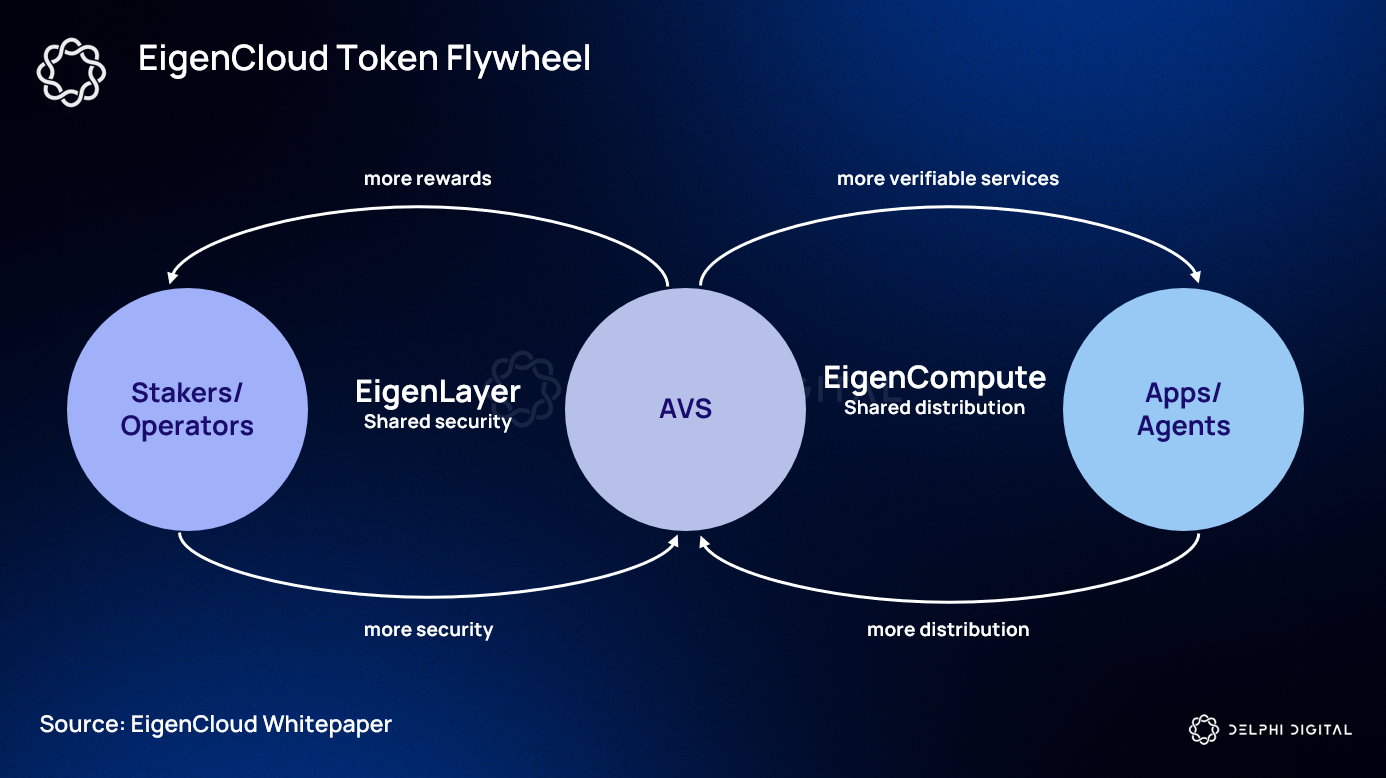
EigenLayer’s EigenDA module approaches the DA problem from a radically different angle. Instead of running its own consensus network, EigenDA leverages Ethereum’s mature validator set through restaking:
- KZG commitments for validity proofs: Enables proactive data verification without waiting for fraud proofs or challenge periods.
- Tied to Ethereum security guarantees: Restaked ETH secures EigenDA, providing robust Sybil resistance and economic alignment with Ethereum’s L1.
- Throughput up to 100MB/s: Ideal for high-frequency dApps requiring rapid blobspace ingestion and near-real-time processing.
- L2-centric architecture: Optimized specifically for the Ethereum ecosystem and its Layer 2 rollups.
The trade-off? Finality on EigenDA is dictated by Ethereum’s block confirmation times - currently about 12 minutes. For builders who need Ether-level security and are already committed to the EVM stack, this latency is often an acceptable compromise in exchange for throughput and composability benefits.
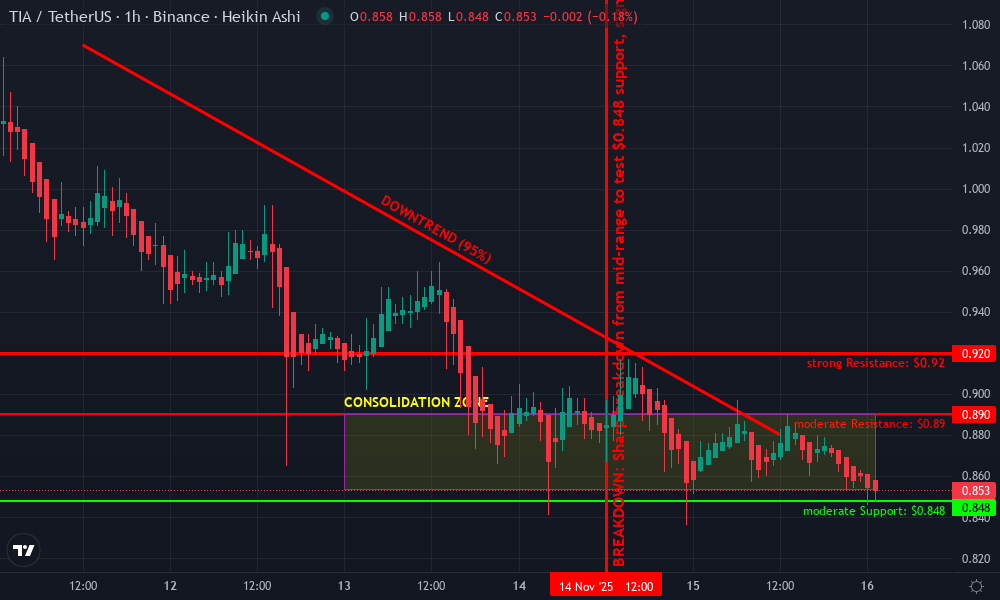
Celestia Technical Analysis Chart
Analysis by Miles Redding | Symbol: BINANCE:TIAUSDT | Interval: 1h | Drawings: 6
Technical Analysis Summary
Draw a primary downtrend line from the high on November 11 to the most recent lower high on November 15. Mark horizontal support at $0.848 and resistance at $0.890, using horizontal lines. Place a rectangle to highlight the consolidation zone between $0.848 and $0.890 from November 13 to November 16. Use a vertical line to highlight the sharp breakdown on November 14. Annotate potential entry (aggressive short below $0.848) and exit (profit target near $0.820, stop loss above $0.890) using order lines and text callouts. For MACD/volume, mark momentum shifts with arrow markers and callouts at reversal attempts.
Risk Assessment: high
Analysis: The trend is aggressively bearish with no clear reversal signs. Support is fragile and breakdown risk is elevated. Only aggressive traders should engage at these levels—risk of sharp downside moves remains high.
Miles Redding's Recommendation: Position for momentum continuation with tight stops. Short breakdowns or failed rallies; avoid trying to catch reversals until price action confirms a base. Stay nimble and let volatility work in your favor.
Key Support & Resistance Levels
📈 Support Levels:
- $0.848 - Immediate horizontal support—multiple tests, potential breakdown trigger. moderate
- $0.82 - Projected next support if $0.848 fails, based on previous wicks and psychological round number. weak
📉 Resistance Levels:
- $0.89 - Recent swing high and upper bound of consolidation zone, likely to cap rallies. moderate
- $0.92 - Previous support turned resistance, now role-reversed after breakdown. strong
Trading Zones (high risk tolerance)
🎯 Entry Zones:
- $0.848 - Aggressive short entry on breakdown below support with momentum confirmation. high risk
- $0.89 - Fade rally into resistance for short setup—downtrend intact. high risk
🚪 Exit Zones:
- $0.82 - Profit target for shorts, next logical support zone. 💰 profit target
- $0.89 - Stop loss for shorts, invalidates immediate breakdown thesis. 🛡️ stop loss
Technical Indicators Analysis
📊 Volume Analysis:
Pattern: Volume spikes on breakdowns and fades during weak rallies, confirming bearish pressure.
Volume surges during red candles, especially on breakdowns, highlighting aggressive selling.
📈 MACD Analysis:
Signal: Bearish bias—MACD likely below signal line and trending down, momentum remains negative.
Momentum hasn't shifted; any bullish MACD cross should be viewed with skepticism unless price reclaims $0.890.
Applied TradingView Drawing Utilities
This chart analysis utilizes the following professional drawing tools:
Disclaimer: This technical analysis by Miles Redding is for educational purposes only and should not be considered as financial advice. Trading involves risk, and you should always do your own research before making investment decisions. Past performance does not guarantee future results. The analysis reflects the author's personal methodology and risk tolerance (high).
Key Metrics: Throughput, Finality and Security Model Comparison
The choice between Celestia vs EigenLayer ultimately hinges on three core dimensions:
- Throughput and Scalability: EigenDA leads on raw throughput ( and gt;100MB/s) but Celestia’s sampling mechanism scales efficiently as more validators join the network.
- Finality Time: Celestia achieves ~10 minutes; EigenDA matches Ethereum at ~12 minutes. Faster sequencing is possible off-chain but not natively finalized on either DA layer yet.
- Security Model: Celestia uses its own PoS chain; EigenDA inherits security from restaked ETH validators - each model presents different attack surfaces and trust assumptions.
- Ecosystem Compatibility: Celestia supports multi-chain deployments; EigenDA is deeply integrated with Ethereum-native rollups.
This table summarizes key differentiators as of November 2025:
6-Month Price Performance: Celestia vs Major DA Layer Tokens (2025)
A side-by-side comparison of Celestia (TIA), Ethereum (ETH), Bitcoin (BTC), and leading DA-related assets for modular dApps.
| Asset | Current Price | 6 Months Ago | Price Change |
|---|---|---|---|
| Celestia (TIA) | $0.8534 | $0.3166 | +169.3% |
| Ethereum (ETH) | $3,152.99 | $1,912.00 | +64.9% |
| Bitcoin (BTC) | $95,377.00 | $81,553.00 | +16.9% |
| Solana (SOL) | $139.18 | $124.00 | +12.2% |
| Avalanche (AVAX) | $15.43 | $15.43 | +0.0% |
| Optimism (OP) | $0.3874 | $0.3874 | +0.0% |
| Arbitrum (ARB) | $0.2399 | $0.2399 | +0.0% |
| Cosmos (ATOM) | $2.84 | $2.84 | +0.0% |
Analysis Summary
Celestia (TIA) has significantly outperformed other major data availability and modular blockchain assets over the past six months, with a 169.3% gain. Ethereum (ETH) and Bitcoin (BTC) have also posted strong gains, while most other DA-related tokens have remained stable.
Key Insights
- Celestia (TIA) leads the sector with a 169.3% price increase over six months, highlighting strong market momentum for modular DA solutions.
- Ethereum (ETH) and Bitcoin (BTC) have delivered robust gains of 64.9% and 16.9%, respectively, reflecting continued investor confidence in established platforms.
- Solana (SOL) showed moderate growth (+12.2%), while Avalanche (AVAX), Optimism (OP), Arbitrum (ARB), and Cosmos (ATOM) remained flat, indicating limited price movement among some alternative DA and L2 tokens.
- The outperformance of Celestia suggests growing interest in modular and blockchain-agnostic data availability solutions for high-speed dApps.
All prices and percentage changes are sourced directly from the real-time market data provided as of November 16, 2025. The table compares current prices with those from six months prior, calculating the 6-month price change for each asset.
Data Sources:
- Main Asset: https://coinmarketcap.com/currencies/celestia/
- Ethereum: https://www.gsr.io/wp-content/uploads/2025/03/Mar-11-2025.pdf
- Bitcoin: https://www.gsr.io/wp-content/uploads/2025/03/Mar-11-2025.pdf
- Avalanche: https://www.gsr.io/wp-content/uploads/2025/03/Mar-11-2025.pdf
- Solana: https://www.gsr.io/wp-content/uploads/2025/03/Mar-11-2025.pdf
- Optimism: https://www.gsr.io/wp-content/uploads/2025/03/Mar-11-2025.pdf
- Arbitrum: https://www.gsr.io/wp-content/uploads/2025/03/Mar-11-2025.pdf
- Cosmos: https://www.gsr.io/wp-content/uploads/2025/03/Mar-11-2025.pdf
Disclaimer: Cryptocurrency prices are highly volatile and subject to market fluctuations. The data presented is for informational purposes only and should not be considered as investment advice. Always do your own research before making investment decisions.
Celestia (TIA) Price Prediction 2026-2031
Professional projections for TIA price evolution versus ETH, considering DA layer market trends, adoption, and competition from EigenLayer and others.
| Year | Minimum Price (Bearish) | Average Price (Base Case) | Maximum Price (Bullish) | % Change (Avg YoY) | Market Scenario Insights |
|---|---|---|---|---|---|
| 2026 | $0.75 | $1.10 | $1.60 | +28.9% | TIA recovers from 2025 lows as modular DA adoption grows; competition keeps upside in check. |
| 2027 | $0.95 | $1.45 | $2.10 | +31.8% | Further rollup adoption and integration with new chains boost demand; ETH-based DA competition persists. |
| 2028 | $1.20 | $1.90 | $2.80 | +31.0% | Celestia benefits from wider modular blockchain acceptance; regulatory clarity supports growth. |
| 2029 | $1.55 | $2.45 | $3.60 | +28.9% | Mainstream rollup deployment and cross-chain dApps drive usage; market volatility increases. |
| 2030 | $1.90 | $3.10 | $4.50 | +26.5% | Celestia cements role as leading DA layer; robust ecosystem and possible bull market cycle. |
| 2031 | $2.25 | $3.75 | $5.60 | +21.0% | Mature DA market, Celestia maintains strong position, but faces plateau as adoption stabilizes. |
Price Prediction Summary
Celestia (TIA) is projected to experience steady growth through 2031, underpinned by its modular data availability solution and increasing adoption in the modular blockchain ecosystem. While competition from EigenLayer and other solutions may limit extreme upside, Celestia's blockchain-agnostic approach and ongoing technical improvements position it as a leading DA layer. Investors should expect both bullish and bearish scenarios, with price volatility reflecting overall crypto market cycles and evolving regulatory environments.
Key Factors Affecting Celestia Price
- Adoption of modular blockchain and rollup technologies
- Competition from EigenLayer (EigenDA), Avail, and future DA solutions
- Market cycles and macroeconomic trends affecting crypto
- Regulatory developments impacting DA layer utility and token value
- Technical improvements (e.g., data availability sampling, scalability)
- Partnerships, integrations, and ecosystem growth
- Ethereum ecosystem performance and restaking trends
Disclaimer: Cryptocurrency price predictions are speculative and based on current market analysis. Actual prices may vary significantly due to market volatility, regulatory changes, and other factors. Always do your own research before making investment decisions.
Evolving Economics: Blobspace Restaking and Predictable Costs
The rise of blobspace restaking models introduces new yield opportunities - especially as protocols seek to optimize both cost efficiency and security guarantees across modular stacks. For dApp teams prioritizing predictable costs or seeking exposure beyond just the EVM ecosystem, Celestia’s pricing model offers strong appeal compared to the variable economics of restaked ETH collateralization in EigenLayer deployments. For more details on how these models impact rollup scalability, see this deep dive: How Data Availability Layers Improve Rollup Scalability in Modular Blockchains.
Real-world deployments in late 2025 are already underscoring the divergent strategies of both DA leaders. Projects prioritizing multi-chain interoperability and cost predictability are gravitating toward Celestia, leveraging its namespaced blob design to isolate rollup data and minimize cross-rollup interference. Conversely, Ethereum-native dApps with stringent throughput and security requirements are increasingly opting for EigenDA, drawn by its ability to deliver near-instantaneous data verification at Ethereum’s security threshold.
It’s important to note that while both networks have made significant progress on scalability, neither has yet achieved sub-5s native finality for DA, an open frontier that may define the next wave of innovation in modular blockchain infrastructure. Builders focused on latency-sensitive applications (e. g. , real-time trading or high-frequency gaming) should closely monitor roadmap updates from both ecosystems as advances in erasure-coded availability and off-chain sequencing could shift the competitive landscape.
Strategic Considerations: Which DA Layer Fits Your Modular Stack?
The decision matrix for DA layer selection is nuanced. Here are practical scenarios:
- Multi-chain or non-EVM rollups: Celestia’s blockchain-agnostic architecture offers maximum flexibility and predictable economics.
- Ethereum-aligned dApps targeting high throughput: EigenDA’s restaked security model and KZG commitments provide unmatched performance for L2-centric deployments.
- Cost-sensitive teams: Celestia’s transparent blob pricing enables more accurate budgeting compared to the fluctuating cost dynamics of ETH restaking.
- Diversified yield strategies: Blobspace restaking is opening new avenues for protocol-level returns, evaluate which ecosystem aligns best with your treasury objectives.
Security remains paramount. While Celestia’s PoS chain is robust, it introduces unique validator incentive dynamics not present in EigenDA’s ETH-aligned model. Assess your application’s risk tolerance before committing to a DA layer, especially if you’re building mission-critical financial primitives or infrastructure components.
Outlook: The Future of Modular Data Availability
The modular blockchain thesis is now entering a phase of rapid specialization. As data availability layers become more sophisticated, expect continued differentiation along axes such as erasure coding efficiency, blobspace market design, sequencing latency, and cross-domain composability. Both Celestia (trading at $0.853376) and Ethereum ($3,140.54) remain bellwethers for capital allocation in the sector, a dynamic likely to persist as institutional adoption accelerates through 2026.
If you’re architecting a high-speed modular dApp stack today, the optimal choice between Celestia and EigenLayer will depend on your specific blend of performance needs, ecosystem alignment, cost structure preferences, and security assumptions. Stay agile: monitor upcoming protocol upgrades across both networks as the pace of innovation remains relentless.
For an expanded technical breakdown on how these DA layers underpin next-generation rollup scalability, and what that means for your project roadmap, explore this resource: Comparing EigenDA and Celestia: Which Modular DA Layer Fits Your Blockchain Project?




No comments yet. Be the first to share your thoughts!